



News:
Brokerage
Posted: December 19, 2017
Israel Bonds holds annual Real Estate and Allied Divisions Luncheon
Pictured above (from left) are: Debrah Lee Charatan, principal, Debrah Lee Charatan Realty Inc., and vice chair, Israel Bonds real estate division of Greater NYS; Andrew Albstein, managing partner at Goldberg Weprin Finkel Goldstein LLP; Greater New York Leadership Council chairman Gary Jacob; and campaign chairman Michael Stoler.
New York, NY On November 9th, Israel Bonds New York held its annual Real Estate and Allied Divisions Luncheon. The event, which has been ongoing for over 50 years, took place at The Pierre Hotel and was attended by an audience of over 600 people. This year’s honorees were Andrew Albstein, managing partner at Goldberg Weprin Finkel Goldstein LLP, and Peter Kalikow, president of H.J. Kalikow & Co., LLC. Albstein and Kalikow were awarded the Israel Peace Medal Award and the Lifetime Achievement Award, respectively.
Luncheon keynote speaker was NYS comptroller Tom DiNapoli, who told his audience, “Israel bonds are a mainstay of our investment portfolio,” noting the state currently holds $130 million in Israel bonds.
Gary Jacob of Glenwood Management and Michael Stoler of Madison Realty Capital, made the award presentations. Jacob serves as chairman of the Israel Bonds Greater New York Leadership Council, and Stoler is real estate campaign chairman. $51 million in Israel bond investments and indications to invest were unvielded at the event.
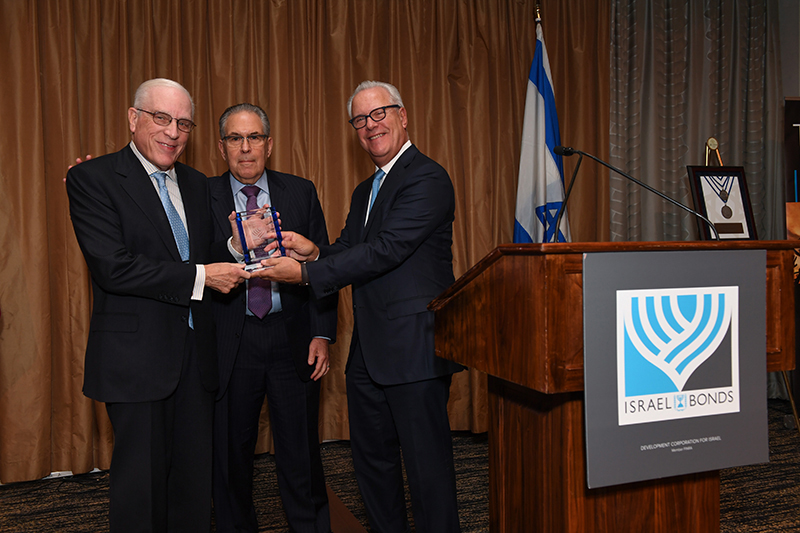
Award by campaign chairman Michael Stoler and Greater New York Leadership Council chairman Gary Jacob.
Tags:
Brokerage
MORE FROM Brokerage

Marcus & Millichap releases fourth-quarter 2026 NYC industrial market report
Manhattan, NY Marcus & Millichap has published its fourth-quarter 2026 New York City Industrial Market Report. “New York City’s industrial market is showing a clear





Quick Hits

Columns and Thought Leadership

New York’s streets are full again, and the retail numbers prove it - by Noam Aziz
Walk down any New York block this year and you can feel it. The sidewalks are crowded, the storefronts are lit, and the energy that defines this city is back at full volume.

Hunt CRE question and answer: Choosing a real estate agent - by David Hunt
First, we will only work with one agent exclusively. The primary reason is that we want that agent to legally represent our client’s interests. In New York State, a real estate agent has a fiduciary

The art of investing in real estate - by Thomas Donovan
Real estate investing is as much an art as it is a skill. No one can time the market, or the factors that drive it, perfectly. Location, zoning, size, transportation, and neighborhood density give you a baseline for

Hunt commercial real estate question and answer: Fortune 500 wisdom - by David Hunt
Yes, there are lessons to be learned from the largest companies in America when comes to managing your real estate. But the decision to buy or lease real estate may not be one of
.gif)