



News:
Brokerage
Posted: July 5, 2016
Investment Sales: Real estate a la French Poète Jacques Prevert by Levy
 Pascal Levy, Besen & Associates
As a foreigner, I can confirm that New York City is a beacon of light for the rest of the world. Foreign capital will continue to seek shelter in New York for all the obvious reasons. Real estate here will always be viewed, in the midterm, as a solid investment that will overcome any “readjustment,” which is sometimes necessary.
As a foreigner I see that the affordable housing program is inefficient. Some action programs (like the 421-a) helped, but were not always properly targeted (i.e. condo projects?). And the guaranty that the tenant can remain in the unit forever (despite the evolution of his income?) seems self-defeating. Crazy system in a country that believes in upward mobility! Why not create a department in charge of consistently checking the ratio income/rent? It would free up so many of those needed affordable apartments for those who truly need them.
This would provide room for more efficient new inclusionary programs, much needed by the developers. That is the people who built the city to make it New York. The full industry (developers, capital providers, banks, lenders, builders or architects) worked together to build the more majestic towers. That said, it is hard to explain how it plays out in Europe where some living on the same floors pay 20% of what their neighbor pays with the same unit (A.M.I oblige).
As a professional, I dont believe the headlines, but rather what I see. We all know the headlines have to catch our eyes by touching our fears. The market is not as they would lead you to believe. Are developers suffering? Well, few of them (the end of the chain, the gambler, under-capitalized or the dreamer). Prices are shaky in the luxury segment (yet the drop in prices is calculated from the last increase from the condo book...(which is sometimes higher than 20% of the original projection). At the end of May 2016, 33 contracts were signed for luxury apartments, a 2016 record.... On the rental side, can we ask for better than 1% vacancy?
Winning in NY is born of the hard work of the New Yorkers. NYC is gifted with beautiful success stories that have made this city unique in the world. It will always be here and better than before. Correction or adjustments are a true necessity to remind us that winning must come with sharing. Diversity is what made this city what it is today.
Pascal Levy is an international director at Besen Associates, New York, N.Y.
Tags:
Brokerage
MORE FROM Brokerage
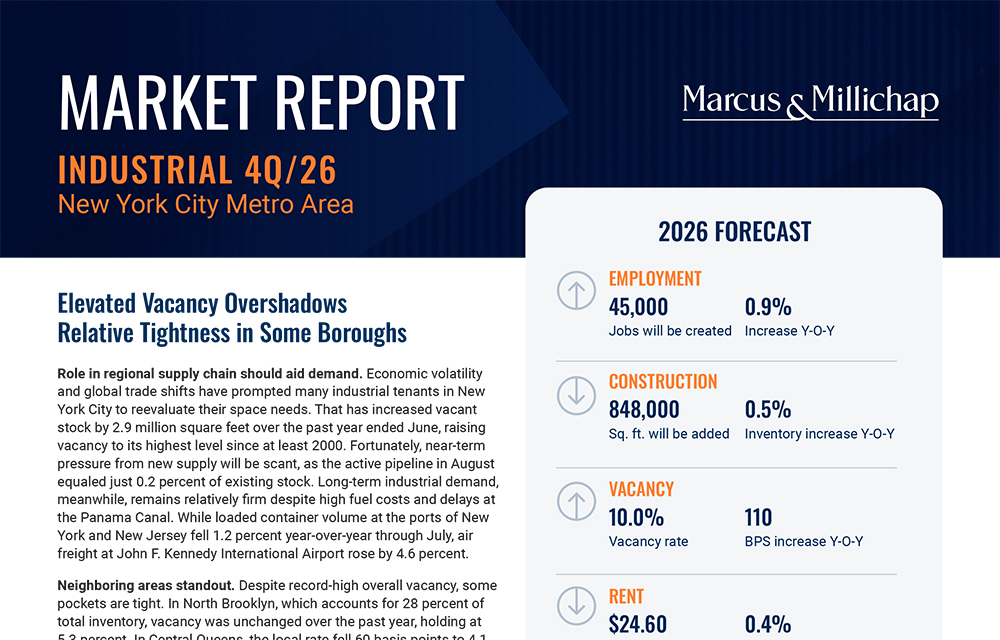
Marcus & Millichap releases fourth-quarter 2026 NYC industrial market report
Manhattan, NY Marcus & Millichap has published its fourth-quarter 2026 New York City Industrial Market Report. “New York City’s industrial market is showing a clear





Quick Hits

Columns and Thought Leadership

Hunt CRE question and answer: Choosing a real estate agent - by David Hunt
First, we will only work with one agent exclusively. The primary reason is that we want that agent to legally represent our client’s interests. In New York State, a real estate agent has a fiduciary

The art of investing in real estate - by Thomas Donovan
Real estate investing is as much an art as it is a skill. No one can time the market, or the factors that drive it, perfectly. Location, zoning, size, transportation, and neighborhood density give you a baseline for

Hunt commercial real estate question and answer: Fortune 500 wisdom - by David Hunt
Yes, there are lessons to be learned from the largest companies in America when comes to managing your real estate. But the decision to buy or lease real estate may not be one of

New York’s streets are full again, and the retail numbers prove it - by Noam Aziz
Walk down any New York block this year and you can feel it. The sidewalks are crowded, the storefronts are lit, and the energy that defines this city is back at full volume.
.gif)