



News:
Brokerage
Posted: November 26, 2024
International Persons with Disabilities Day to be observed on Dec. 3
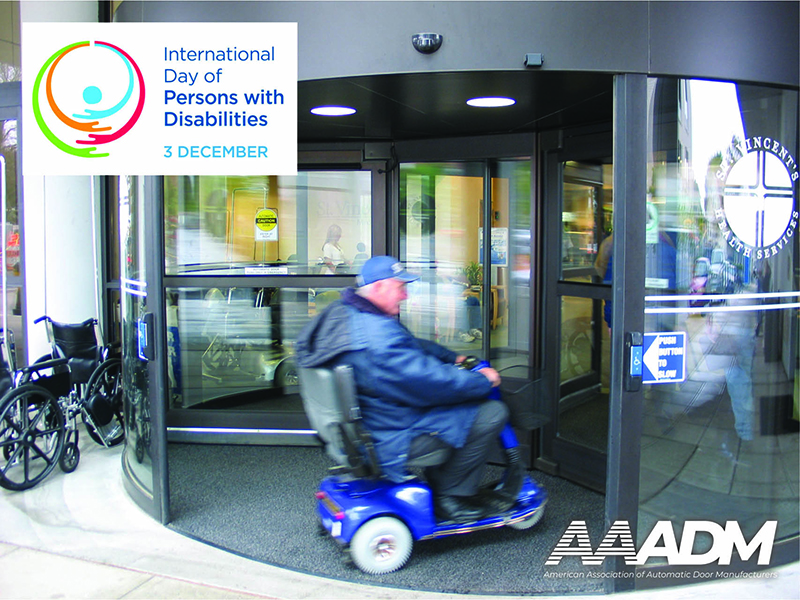
New York, NY International Persons with Disabilities Day is observed each Dec. 3, shining a light on the importance of removing physical barriers for the over one billion people worldwide living with disabilities. The American Association of Automatic Door Manufacturers (AAADM) works hard to amplify the message that these efforts benefit society as a whole.
The integration of automatic doors into building design — particularly those deemed public gathering places, such as restaurants, transportation hubs, grocery and convenience stores, schools and universities, and work places — is a practical way to support the principles of International Persons with Disabilities Day and a great example of how design and technology can align to help foster a more inclusive and accessible world.
Automatic doors eliminate or significantly reduce the need for physical effort to open them. By removing barriers to entry, automatic doors help people with disabilities move through spaces more independently because they don’t need to rely on others for assistance.
Automatic doors are part of a broader effort to create environments where everyone, regardless of their physical abilities, can participate equally. Their presence at doorways and entrances is a step toward designing spaces that are welcoming and accommodating to all individuals.
AAADM is a strong advocate for increasing public access, working to make changes to the International Building Code (IBC) that increase placement of automatic doors. This includes requiring automatic doors at public entrances of buildings that meet certain occupancy thresholds, ensuring that at least one door is either a full power-operated or a low-energy power-operated door.
The IBC updates reflect a broad recognition of the role automatic doors play in enhancing accessibility and accommodating various needs that make traditional doors challenging or impossible to use.
Ensuring physical access to facilities—whether for voting, shopping, dining, or essential services—is essential for the independence of individuals with disabilities. Automatic doors are a vital element in providing autonomy and ease of access for those facing physical and mobility challenges.
Established by the United Nations in 1992, International Persons with Disabilities Day promotes advocacy for the rights and well-being of individuals with disabilities and to heighten awareness of their challenges in political, social, economic, and cultural realms.
For more information about AAADM, visit https://www.aaadm.com/.
Tags:
Brokerage
MORE FROM Brokerage

200E20TH sells out in Gramercy, penthouse A closes out sales at the CetraRuddy-designed condominium residences
Manhattan, NY 200E20TH, the CetraRuddy-designed architectural masterwork that brought a curved, contemporary sensibility to Gramercy’s Beaux-Arts streetscape, has





Quick Hits

Columns and Thought Leadership

New York’s streets are full again, and the retail numbers prove it - by Noam Aziz
Walk down any New York block this year and you can feel it. The sidewalks are crowded, the storefronts are lit, and the energy that defines this city is back at full volume.

The art of investing in real estate - by Thomas Donovan
Real estate investing is as much an art as it is a skill. No one can time the market, or the factors that drive it, perfectly. Location, zoning, size, transportation, and neighborhood density give you a baseline for

Hunt commercial real estate question and answer: Fortune 500 wisdom - by David Hunt
Yes, there are lessons to be learned from the largest companies in America when comes to managing your real estate. But the decision to buy or lease real estate may not be one of

Hunt CRE question and answer: Choosing a real estate agent - by David Hunt
First, we will only work with one agent exclusively. The primary reason is that we want that agent to legally represent our client’s interests. In New York State, a real estate agent has a fiduciary
.gif)