



News:
Brokerage
Posted: October 16, 2012
IDA of the Month: Members of the Newtown EDC continue to work together on innovative and efficient practices
Members of the Newtown Economic Development Commission continue to work together with the Town's permitting staff on innovative practices to fast track development projects through the permitting process. The fast track practice is supported by First Selectman Patricia Llodra who sees the team effort as a means to make the permitting process more efficient and expeditious so that developers and home owners can start construction and occupy their newly constructed projects in a timely and satisfying way. The faster track is a reliable and meaningful practice that has the potential to boost new development by attracting companies that need to expand operations within a short time frame. The practices directly support the strategic plan for the economic development of the town by bringing new projects to completion faster.
The First Selectman emphasized that cooperation and communication are the cornerstones of the effort to streamline the process and that Newtown is committed to reduce the time between the filing of an application and obtaining a permit. Before applications are filed, Town staff will meet with the prospective developers or businesses to inform them of permitting requirements and the time frame for the process. If a project is complicated, then several meetings are possible. The goal is to be sure that the applicant clearly understands what is expected and necessary for approvals. The practice encourages staff to communicate with the applicants throughout the application process and facilitates the free exchange of information. Newtown's practices have already shown results. A recent review by the Land Use Director shows that the average time for an application approval is fifty days. The practice effectively brought more than ten development projects from application to approval within fifteen to 78 days.
The Economic Development Commission sees this record as proof that Newtown has a dedicated and innovative permitting team in place. Yet, they remain committed to improving it further. Staff agrees that the development community plays an important part of the formula by providing the needed plans and information in a timely manner. They must work together and communicate throughout the process to be sure that all regulations are complied with and that the review boards have the information that they need for a successful and timely approval.
The EDC is supporting Newtown businesses in other ways and is encouraging them to undertake property enhancements and upgrades that will help to revitalize the various business centers in town. The Main Street Improvement Fund Program that was recently funded by the State of Connecticut provides incentives to commercial property owners that undertake façade and streetscape improvements. Such improvements help to beautify the centers, enhance business development, provide jobs and connect neighborhoods. Newtown's plans and policies emphasize the important roll that aesthetics and convenience play in attracting customers to its commercial centers. The plans encourage private property owners to invest in their commercial areas, create jobs and contribute to the overall quality of life in the community. Newtown is hopeful that it will be successful in its grant application. Already, fifteen business owners have committed to invest more than $1.38 million in streetscape and façade upgrades in the commercial centers.
Newtown has many opportunities for new business development in its commercial and industrial districts. One example is in Hawleyville, off exit 9 of I-84 which has ample land available to support major commercial development. Development will require an investment in extending a sewer line in the area and the town is working on a plan to help move this forward. The potential for significant growth will provide new economic opportunities, local services, jobs and new tax revenue.
The Newtown Technology Park which is located off exit 10 of I-84 provides another option. Local wetlands approvals are in place for a driveway to serve the 23-acre parcel that has the potential to support approximately 100,000 s/f of building area and adjacent parking. The EDC is targeting technology related businesses and service industries to occupy the park.
Another town owned property that the commission continues to market is the Fairfield Hills Campus where limited potential for commercial use has been identified. As a redevelopment parcel served by public utilities and major roadways, it is an attractive property. The town plans to use a $400,000 STEAP grant for new walkways, lighting, and parking areas. Remediation, renovation and demolition of several obsolete buildings are still a challenge but one worthy of creative solutions. In May of this year, the federal EPA awarded the town a Brownfields cleanup grant of $200,000 to assist with the ongoing redevelopment. The commission is committed to continue to work with the town to see that the economic potential for this property is realized.
Elizabeth Stocker, AICP is Newtown's director of economic and community development and first VP of the Connecticut Economic Development Association.
Tags:
Brokerage
MORE FROM Brokerage
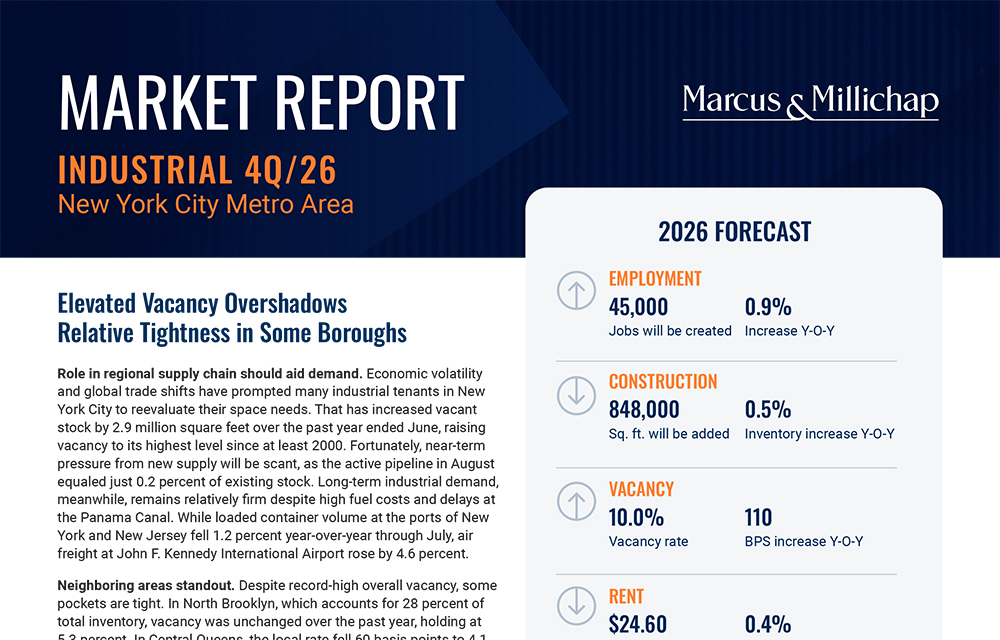
Marcus & Millichap releases fourth-quarter 2026 NYC industrial market report
Manhattan, NY Marcus & Millichap has published its fourth-quarter 2026 New York City Industrial Market Report. “New York City’s industrial market is showing a clear






Columns and Thought Leadership

Hunt commercial real estate question and answer: Fortune 500 wisdom - by David Hunt
Yes, there are lessons to be learned from the largest companies in America when comes to managing your real estate. But the decision to buy or lease real estate may not be one of

New York’s streets are full again, and the retail numbers prove it - by Noam Aziz
Walk down any New York block this year and you can feel it. The sidewalks are crowded, the storefronts are lit, and the energy that defines this city is back at full volume.

Hunt CRE question and answer: Choosing a real estate agent - by David Hunt
First, we will only work with one agent exclusively. The primary reason is that we want that agent to legally represent our client’s interests. In New York State, a real estate agent has a fiduciary

The art of investing in real estate - by Thomas Donovan
Real estate investing is as much an art as it is a skill. No one can time the market, or the factors that drive it, perfectly. Location, zoning, size, transportation, and neighborhood density give you a baseline for
.gif)