



News:
Brokerage
Posted: May 30, 2023
Fordham Real Estate Institute hosts U.S. representative Torres; led by Freedman of Brown Harris Stevens in discussing “Housing the Next Generation”
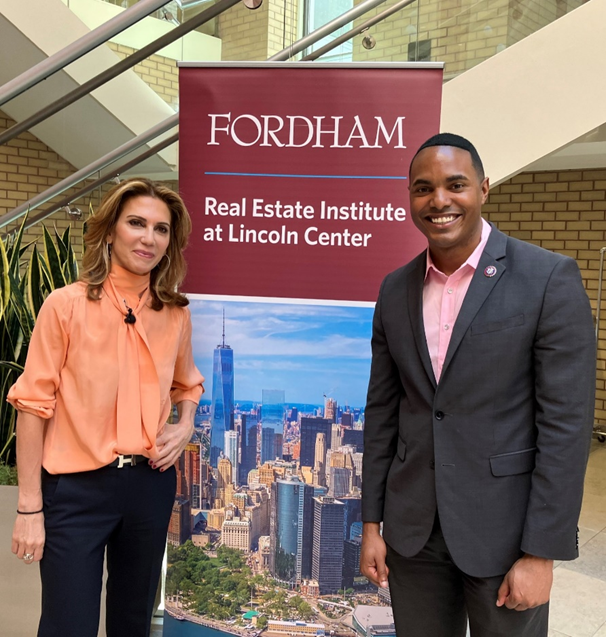
Manhattan, NY The Fordham Real Estate Institute (REI) hosted U.S. representative Ritchie Torres, at its Lincoln Center campus for a conversation about affordable housing in New York City, led by Bess Freedman, CEO of Brown Harris Stevens (BHS) and member of REI’s Executive Advisory Council (EAC) of industry and business leaders. The event was part of REI’s “Titan Talks” series, which features one-on-one discussions with leaders shaping the real estate industry and New York City’s landscape.
Students and real estate professionals gathered to hear representative Torres, who represents New York’s 15th congressional district, discuss “Housing the Next Generation of New Yorkers” and explain legislation and other efforts to protect and expand the city’s affordable housing stock. The Bronx Democrat also shared his own personal journey, from living in public housing to advocating in Washington for those in need of housing.
“I was born and raised in the Bronx, living the majority of my life in poverty,” said Torres. “My most formative experience was growing up in public housing … my mother struggled every day to support her three children on $4.25 an hour, the minimum wage in the 1990s. Today, when demand for affordable housing far exceeds supply, there’s no path for solving our current crisis without creating more affordable housing. That’s just common sense.”
Freedman noted the recent defeat of governor Kathy Hochul’s controversial plan to create new affordable housing through production mandates and other measures: “Whether you agree or disagree with her approach, we still have a housing affordability crisis in New York city and the state. Where do we go from here?” Freedman said.
“In New York City, one of the greatest stumbling blocks to confronting the housing crisis is autocracy masquerading as democracy,” Torres said. “For example, our current land-use zoning process, where a small, vocal minority can get in the way of affordable housing development – that’s going to prevent us from solving problems like the affordability crisis.”
Torres emphasized a need to expand both housing supply and subsidies, and noted a “practical solution” he introduced in Congress to expand the housing choice voucher program for certain low-income families and guarantee residents pay no more than 30 percent of their income to rent.
“Another proposal is expanding upon the most effective housing program in New York City history – Mitchell-Lama – and creating a national model that scales those successes and ensures a more diversified housing stock for the middle class,” Torres said, referring to the housing program that provides affordable rental and cooperative housing to moderate- and middle-income families.
When asked by Freedman how New York City can incentivize the building of more affordable housing among developers, Torres said, “We either need property tax reform or 421a (property tax exemption), and if you have neither one, it’s effectively a moratorium on affordable housing in New York City.”
Asked by a member of the audience what can be done to move beyond the polarization of politics, NIMBYism, fear of gentrification and other obstructions to creating more affordable housing, Torres replied, “It’s not necessarily an issue of the left versus the right. In certain communities like mine in the South Bronx, the most prevalent concern and fear is about gentrification and displacement.”
“Elsewhere, people say we want to keep our neighborhoods downzoned to exclude certain communities and much of that is racially coded,” Torres added. “But in the progressive movement there’s a likening toward promoting development that meaningfully addresses affordable housing, and if that level of YIMBYism (yes, in my backyard) continues to grow to tides of climate change as top issues in political circles, we’ll see more action and progress.”
Fordham Real Estate Institute (REI) hosted its “Titan Talks” event series May 8, 2023 featuring U.S. Rep. Ritchie Torres and Bess Freedman, CEO of Brown Harris Stevens and member of REI’s Executive Advisory Council. Photo credit: Fordham University.
Tags:
Brokerage
MORE FROM Brokerage

Marcus & Millichap releases fourth-quarter 2026 NYC industrial market report
Manhattan, NY Marcus & Millichap has published its fourth-quarter 2026 New York City Industrial Market Report. “New York City’s industrial market is showing a clear





Quick Hits

Columns and Thought Leadership

Hunt commercial real estate question and answer: Fortune 500 wisdom - by David Hunt
Yes, there are lessons to be learned from the largest companies in America when comes to managing your real estate. But the decision to buy or lease real estate may not be one of

New York’s streets are full again, and the retail numbers prove it - by Noam Aziz
Walk down any New York block this year and you can feel it. The sidewalks are crowded, the storefronts are lit, and the energy that defines this city is back at full volume.

The art of investing in real estate - by Thomas Donovan
Real estate investing is as much an art as it is a skill. No one can time the market, or the factors that drive it, perfectly. Location, zoning, size, transportation, and neighborhood density give you a baseline for

Hunt CRE question and answer: Choosing a real estate agent - by David Hunt
First, we will only work with one agent exclusively. The primary reason is that we want that agent to legally represent our client’s interests. In New York State, a real estate agent has a fiduciary
.gif)