


 (2).gif)
News:
Finance
Posted: June 5, 2009
Dealing with green building and lease issues: How do landlords and tenants decide who covers costs?
The term "green buildings" generally refers to buildings constructed, maintained or operated in accordance with certain energy efficient performance standards established by various industry groups. Green buildings use resources, such as energy and land, more efficiently than buildings constructed under basic building codes. Given the developing trend toward construction and operation of green buildings, counsel representing commercial landlords and tenants need to be increasingly aware of memorializing green leasing issues or otherwise addressing green obligations in leases between landlord and tenant to maintain green ratings.
Green Building Ratings
Though there are many different standards that can be used to establish a green building (e.g., Green Globes, Proposed Standard 189, Green Building Underwriting Standards), the Leadership in Energy and Environmental Design (LEED) rating system established by the U.S. Green Building Council is the predominant nationally recognized standard. To be LEED certified, a project must be registered with LEED and must meet a minimum number of "points." Certification is awarded based on performance benchmarks (credits) for certain categories, such as energy efficiency, water savings, materials selection, sustainable site development and indoor environmental quality. There are several building types that can be certified by LEED including: New Construction and Major Renovations; Existing Buildings: Operations & Maintenance; Commercial Interiors; and Core & Shell.
Connecticut Green Building Initiatives
Although the ultimate outcome of recent legislative efforts remains unclear, Connecticut is in the process of turning its State Building Code (code) green by incorporating green building rating systems into it. For example, provisions in Public Act 07-242 (an Act concerning electricity and energy efficiency) amended the General Statutes to require the revision of the code so that certain buildings constructed after January 1, 2009 or renovated after January 1, 2010, be built using standards consistent with or exceeding the LEED "silver" rating standard or an equivalent standard. See P.A. 07-242 § 78; Conn. Gen. Stat. Ann. § 29-256a (West 2009). At the time of this writing, a revised code has not yet been adopted. In addition, the act amended the general statutes by requiring that certain new construction or renovation projects of state facilities utilize the LEED "silver" rating standards. See P.A. 07-242 § 10; Conn. Gen. Stat. Ann. § 16a-38k. It should be noted that two bills were introduced during the 2009 Legislative Session that, if passed, would amend these statutes. (See Substitute House Bill No. 6284 and governor's Bill No. 6377)
Another green building initiative in Connecticut takes the form of an Executive Order issued by governor Rell in February 2008, which requires that all future equipment and appliances purchased by and for executive branch state agencies be Energy Star certified. "Energy Star" refers to a voluntary labeling program designed to identify and promote energy-efficient products to reduce greenhouse gas emissions.
Green Lease Issues
One result of the rise in the number of green buildings is that there is and will be an increasing demand to memorialize key green obligations in leases between landlord and tenant to maintain green ratings. While the concept of a green lease is in a relatively early stage of development and there is no precise or singular definition of what constitutes one, several important issues should be kept in mind when leasing space in a green building.
Who Gets Credit for What - Tenant or Landlord?
Drafters of a lease involving space in a green building will want to specify who receives credit for satisfying the performance benchmarks that result in LEED certification. Receiving such green credit is significant because different parties have different "drivers" to obtaining LEED certification. Drivers may include meeting new legal requirements, saving energy costs, obtaining tax credits, attracting tenants or simply to fulfill certain corporate policies. In certain circumstances, the landlord and/or the tenant can receive credit, thus making it important to spell out in the lease who receives green credit and for what activities credit may be earned. For example, under the LEED rating system for new construction and major renovation projects, the owner usually takes all green credits. However, the LEED rating systems for core & shell and commercial interiors recognizes the division between owner and tenant and permits both the landlord and tenant to independently obtain LEED certification.
Allocation of Capital and Operating Expenses in a Green Lease
A green lease should also specify whether the landlord or tenant is required to pay for capital expenses incurred in obtaining green certification. For example, the tenant can pay the pro rata share of the capital expenses or pay the pro rata share, but prorated over time. Another alternative is to require the tenant to only pay for capital expenses that save or are intended to save on operating expenses.
As for operating expenses, one issue specific to green leases is whether the costs of green compliance, certification and re-certification are to be considered operating expenses that can be passed through to the tenant. Under traditional "net leases," the tenant generally pays a base rent plus reimbursement for certain operating expenses such as energy, water, and taxes. Thus, under these leases the landlord passes operating expenses through to the tenant and there is no incentive for the landlord to adopt policies that conserve resources. By contrast, under a "gross lease," with no pass through of operational expenses to the tenant, the landlord is more apt not to waste resources, since the landlord is responsible for paying for them. Landlords, however, generally do not like gross leases and are unlikely to agree to them just to "go green."
Other Potential Green Lease Issues
After a green build-out of a tenant's space, there may be operational issues that need to be addressed in a lease. A green build-out can include such activities as installing Energy Star equipment, updating the HVAC system, or adding windows to the space. Yet, the LEED Existing Buildings: operations & maintenance rating system does not distinguish between what is a landlord and what is a tenant responsibility. Thus, as to sustainability, the landlord should consider adding a covenant in the permitted use section of the lease which states that the tenant's use of the space will comply with the landlord's sustainability goals. The lease should then specify those goals or benchmarks. Other ongoing operational issues that may need to be addressed in a lease include the use of green materials in the tenants space, tenant water usage, and the indoor environmental quality of the tenant's space.
Model Green Leases
Several organizations have either developed model green leases or are in the process of developing green lease riders that can be used with traditional lease agreements. Two popular model leases include the Building Owners and Managers Association International's Guide to Writing a Commercial Real Estate Lease, Including Green Lease Language and the Real Property Association of Canada's National Standard Green Office Lease for Single-Building Projects Version 1.02-2009, which was released on March 30, 2009 and is available on the REALpac website. Both model leases are pro-landlord, but can be modified to transfer some control to the tenant. Furthermore, the Natural Resources Defense Council and the U.S. Green Building Council are developing green lease riders that can be used with traditional lease agreements.
Suzanne Avena is the chair of the Environmental Law Practice and Jason Scott is an associate at Garfunkel, Wild & Travis, Great Neck, N.Y. and Stamford, Conn.
Tags:
Finance
MORE FROM Finance
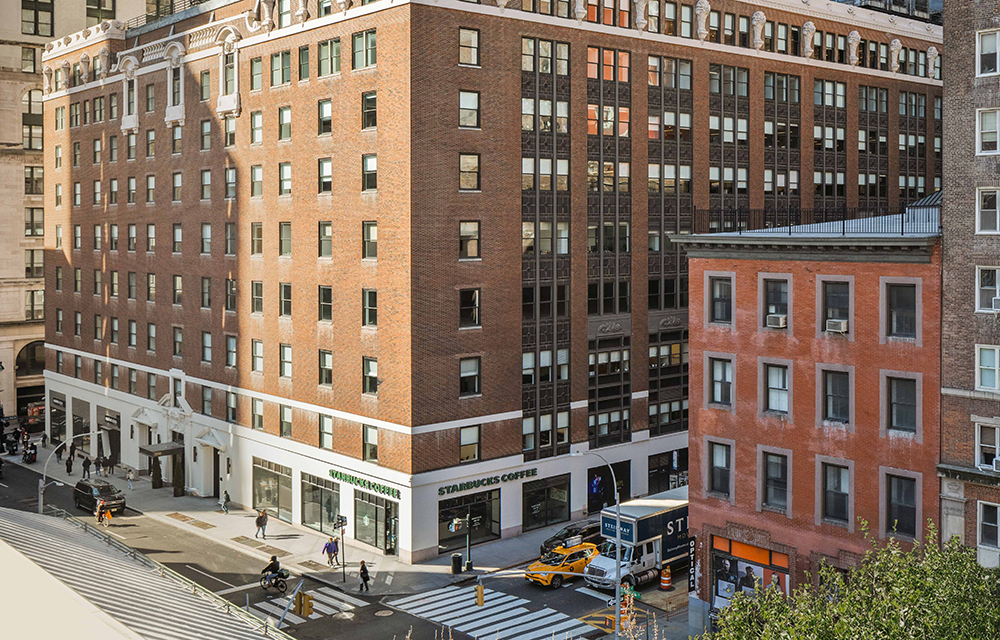
George Comfort & Sons completes $386 million refinance of 200 Madison Ave.
Manhattan, NY George Comfort & Sons, and its partners Loeb Partners Realty and Jamestown, completed a $386 million refinancing of 200 Madison Ave., its 750,000 s/f Grand Central district office

 (2).gif)

Quick Hits
.jpg)

