



News:
Spotlight Content
Posted: December 29, 2008
Citadel, FXFOWLE and Flack + Kurtz complete 27,000 s/f National Audubon Society headquarters
The 27,000 s/f newly designed and built headquarters of the National Audubon Society not only fulfills the organization's stated mission "to conserve and restore natural ecosystems...for the benefit of humanity and the earth's biological diversity," it creates a standard of excellence in green construction that others will strive to emulate. Occupying the entire seventh floor of 225 Varick St., the renovated space is expected to exceed the criteria for a Platinum LEED Commercial Interior (CI) set forth by the U.S. Green Building Council (USGBC). The team for the design and construction project consisted of Citadel Construction Corp., FXFOWLE Architects, PC, and WSP Flack + Kurtz.
The National Audubon Society wanted a green space that would work in harmony with its urban environment by reducing energy consumption and the emission of greenhouse gases and improving indoor air quality and employees' workplace wellbeing.
Since the space once housed a high-ceilinged printing company, it retained an airy, loft-like feel. To accentuate this, the Citadel team created an HVAC system that eliminated overhead duct work. A raised floor facilitates the distribution of hot and cool air through over 200 individual air outlets located in the floor. The gas-powered heating and cooling systems use no chlorofluorocarbons and operate independently of the other floors in the 12-story, 1926 building.
Citadel used only low VOC substances in construction and sustainable, recyclable or reclaimed materials to build and furnish the offices. Floors are bare concrete treated with a sealant or natural cork; countertops are made from compressed paper products or recycled glass. Most project wood was either salvaged or certified by the Forest Stewardship Council (FSC).
Citadel project executive Ronald Welsh, LEED AP, said, "The project team was all of one mind. Clearly, what we build now has a direct impact on the environment; to that end we approach each and every project with the utmost sensitivity and foresight."
Tags:
Spotlight Content
MORE FROM Spotlight Content
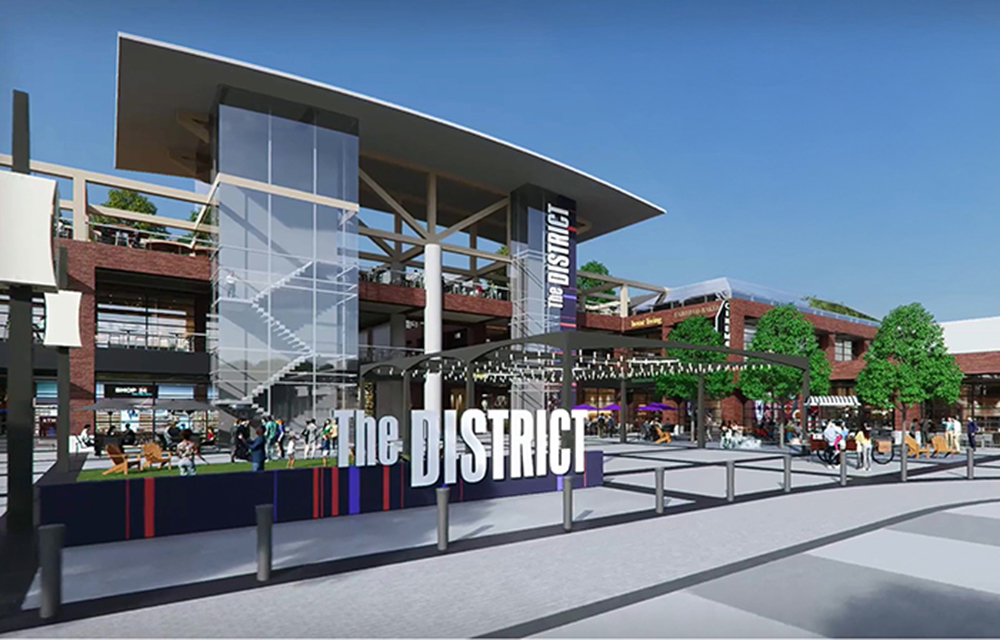
2026 Developing Long Island: The Shops on Broadway
Hicksville, NY The Shops on Broadway is transforming one of Long Island’s most recognizable retail properties into a vibrant new destination. At the heart of the redevelopment is The District, an open-air environment designed by SPECTOR Companies around dining, entertainment, gathering, and community.

.png)

Quick Hits


Columns and Thought Leadership

Properly serving a lien law Section 59 Demand - by Bret McCabe
Many attorneys operating within the construction space are familiar with the provisions of New York Lien Law, which allow for the discharge of a Mechanic’s Lien in the event the lienor does not commence an action to enforce following the service of a “Section 59 Demand”.

From vacancy to vitality: How adaptive reuse is reshaping Long Island’s CRE landscape - by Andrea Tsoukalas Curto
Adaptive reuse has become one of the most important conversations in commercial real estate today. Long Island has a large inventory of aging retail, office and industrial

2026 Developing Queens: Long Island Board of Realtors advances commercial growth and advocacy in Queens
The Long Island Board of Realtors (LIBOR) Commercial Network continues to play a key role in advancing opportunities and strengthening the commercial real estate landscape across Queens. Through targeted programming and global outreach

CRE Guide Featured Company: Merritt Environmental Consulting Corp.
Merritt Environmental Consulting Corp. (MECC) was established in June of 2009 after being part of a larger engineering firm for almost 20 years. The focus of the company is to assist lending institutions, attorneys, real estate investors, and property owners with environmental concerns. Today, MECC has offices in New York, Florida, and Vermont and has grown into a regional consulting firm serving clients along the East Coast.
September Promotion
