



News:
Brokerage
Posted: August 26, 2025
2025 Manhattan retail report: Sustained market fundamentals, even as headwinds emerge
Manhattan, NY The Real Estate Board of New York (REBNY) released its H1 2025 Manhattan Retail Report, which examines activity along major retail corridors in the borough from January to June 2025. The latest biannual study noted steady leasing across the borough with retailers proceeding with increased caution more recently in response to economic uncertainty. Average rents rose in many corridors and dwindling concessions have pushed many retailers to search beyond prime submarkets.
The average asking rent rose or was unchanged in eight out of 17 corridors surveyed in this report compared to H2 2024. Corridors with the highest jumps in demand were Broadway in Soho with 24.1% increase in average asking rents, Upper Fifth Ave. (49th St.-59th St.) with a 17% increase and Columbus Circle with a 14.9% increase. Several corridors posted declines due to the lease up of quality storefronts.
Top performing corridors through the first six months of the year reflected the core drivers of the city’s retail recovery – steady regional labor markets and income growth, a luxury retail rally, resurgent tourism and steady return-to-office rates. Tenants requiring larger retail spaces have been active in Chelsea and Tribeca.
Luxury apparel and accessories absorbed most of the quality storefronts on Madison Ave. and in SoHo several quarters ago. Tenants have pushed to Upper Madison/East Side/West Side, the Plaza District and Park Ave. Sustained daytime commuter activity combined with tourism attractions boosted foot traffic and leasing activity along corridors in Grand Central/Bryant Park, Midtown East and West. Off and on tariff increases and the associated increases in economic uncertainty rattled consumer and business confidence in April and May. Brokers surveyed for the report noted a modest increase in retailers tapping the brakes on leasing decisions.
“Manhattan offers a unique synergy of culture, entertainment and art that can be found in only a handful of other cities around the globe,” said Keith DeCoster, vice president of market data and policy at REBNY. “A wide range of retailers from expanding domestic brands to those making their debut here continue to recognize the unique opportunity that a Manhattan presence affords them. So far, this is helping the retail rally push through tourism disruptions and uncertain trade policy.”
Tags:
Brokerage
MORE FROM Brokerage
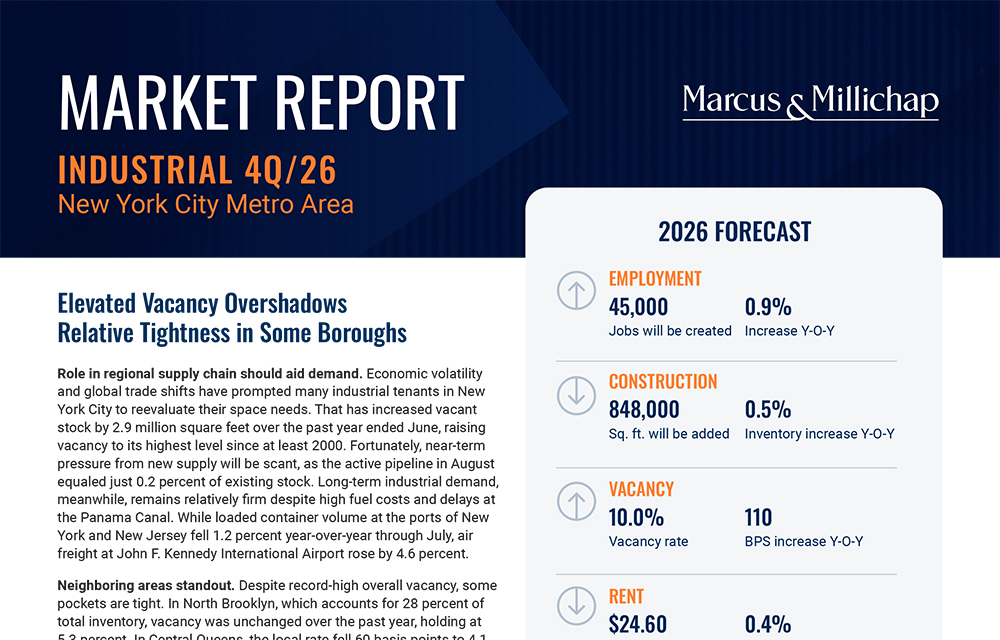
Marcus & Millichap releases fourth-quarter 2026 NYC industrial market report
Manhattan, NY Marcus & Millichap has published its fourth-quarter 2026 New York City Industrial Market Report. “New York City’s industrial market is showing a clear



Quick Hits

Columns and Thought Leadership

New York’s streets are full again, and the retail numbers prove it - by Noam Aziz
Walk down any New York block this year and you can feel it. The sidewalks are crowded, the storefronts are lit, and the energy that defines this city is back at full volume.

The art of investing in real estate - by Thomas Donovan
Real estate investing is as much an art as it is a skill. No one can time the market, or the factors that drive it, perfectly. Location, zoning, size, transportation, and neighborhood density give you a baseline for

Hunt commercial real estate question and answer: Fortune 500 wisdom - by David Hunt
Yes, there are lessons to be learned from the largest companies in America when comes to managing your real estate. But the decision to buy or lease real estate may not be one of

Hunt CRE question and answer: Choosing a real estate agent - by David Hunt
First, we will only work with one agent exclusively. The primary reason is that we want that agent to legally represent our client’s interests. In New York State, a real estate agent has a fiduciary
.gif)