


 (2).gif)
News:
Spotlight Content
Posted: September 20, 2016
Town of New Castle acquires 400-seat Wallace Auditorium
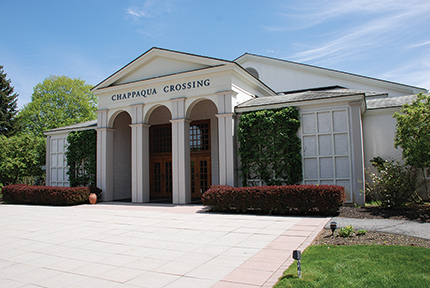 Wallace Auditorium - Chappaqua, NY
Chappaqua, NY During their lifetimes, Reader’s Digest founders Dewitt and Lila Acheson Wallace were well known for their generosity not only in dealing with their thousands of employees worldwide, but with their philanthropic endeavors from support of activities close to home and around the globe. It therefore is fitting that the last building they added to the 114-acre world headquarters campus – the 1986 Wallace Auditorium – has been given to the town of New Castle by Summit/Greenfield Partners, their successors in owning the property.
The 400-seat auditorium is a free-standing building on the hill overlooking the nearly 700,000 s/f office building that the Wallaces began in 1939 with construction of the signature Cupola Building and added onto six times as their thriving publishing business grew. The 13,000 s/f auditorium was added to provide a conference facility for corporate meetings and employee gatherings. It was situated as separate from, but near to the headquarters building.
Following Summit/Greenfield’s purchase of the campus in 2004, the property became Chappaqua Crossing. The Digest remained and presumably would be a long-term tenant. The company retained the right to use the conference center. However, the world of publishing rapidly changed as the Internet Age took hold, and the Digest began to reduce its staff. After 70 years in Chappaqua, at the end of 2009 the final Digest employees left the site.
As Reader’s Digest’s operations shrunk, its use of the auditorium dwindled. Summit/Greenfield made it available to other office tenants on the site and also used a portion of the building for a Chappaqua Crossing information center.
At the same time, the new owners continued the tradition of the Wallaces and Reader’s Digest of making the auditorium (as well as other parts of the property) available at no charge to community groups. Over the last 10 years it has hosted a variety of community-based functions and events.
Now, with the future development plans for the campus in place, the question of what was to be done with the Wallace Auditorium came to the fore. It does not figure in the plans of Summit/Greenfield approvals for the property that include the construction of 91 market rate townhomes in the area adjacent to the auditorium, as well as the addition of 120,000 s/f of commercial retail space at the south end of the property, the conversion of the Cupola Building to The Apartments at Chappaqua Crossing and the continued leasing of some 450,000 s/f of former Reader’s Digest office space.
With this in mind, Summit/Greenfield made an offer to donate the auditorium to the town rather than demolish the building. The town accepted. The Town Board has voted to lease the building for $1 a year through December 31, 2017 at which time it will take title to the property. The town intends to renovate the hall for use as a performing arts center.
“We are delighted that the auditorium will be preserved and have new life as a community resource and theater for the town,’’ said Summit Development president Felix Charney, a partner in Summit/Greenfield. “This will be an appropriate use for the facility and will complement everything we will be doing at Chappaqua Crossing. We are an important component of the town and we want the residents to feel welcome here. We also respect the many community traditions established by the Wallaces and we are pleased to play a part in continuing them.”
New Castle town supervisor Robert Greenstein said that the auditorium will be “an incredible asset for the town,” and pointed to the economic and cultural benefits that other performing arts centers had brought to neighboring communities such as Pleasantville, which is home to the Jacob Burns Film Center.
Tags:
Spotlight Content
MORE FROM Spotlight Content
Participate in Developing New York Featuring Westchester County - November 24, 2026
Choose how you’d like to participate in this edition of NYREJ’s Developing New York series featuring Westchester County.




.png)



Columns and Thought Leadership

2026 Developing Long Island: ERG Commercial Real Estate launches its new Retail Leasing division
North Hempstead, NY ERG Retail Leasing is the dedicated leasing division of ERG Commercial Real Estate, an established full-service commercial real estate brokerage for over 35 years.

From vacancy to vitality: How adaptive reuse is reshaping Long Island’s CRE landscape - by Andrea Tsoukalas Curto
Adaptive reuse has become one of the most important conversations in commercial real estate today. Long Island has a large inventory of aging retail, office and industrial

CRE Guide Featured Company: Merritt Environmental Consulting Corp.
Merritt Environmental Consulting Corp. (MECC) was established in June of 2009 after being part of a larger engineering firm for almost 20 years. The focus of the company is to assist lending institutions, attorneys, real estate investors, and property owners with environmental concerns. Today, MECC has offices in New York, Florida, and Vermont and has grown into a regional consulting firm serving clients along the East Coast.

2026 Developing Queens: Long Island Board of Realtors advances commercial growth and advocacy in Queens
The Long Island Board of Realtors (LIBOR) Commercial Network continues to play a key role in advancing opportunities and strengthening the commercial real estate landscape across Queens. Through targeted programming and global outreach