



News:
Spotlight Content
Posted: March 25, 2008
Steiner NYC chooses GreenbergFarrow to design 114-unit 80 Metropolitan
GreenbergFarrow, a nationally prominent architectural, planning, engineering and development consulting firm, has been tapped by Steiner NYC to design a warehouse-inspired condominium and townhouse development.
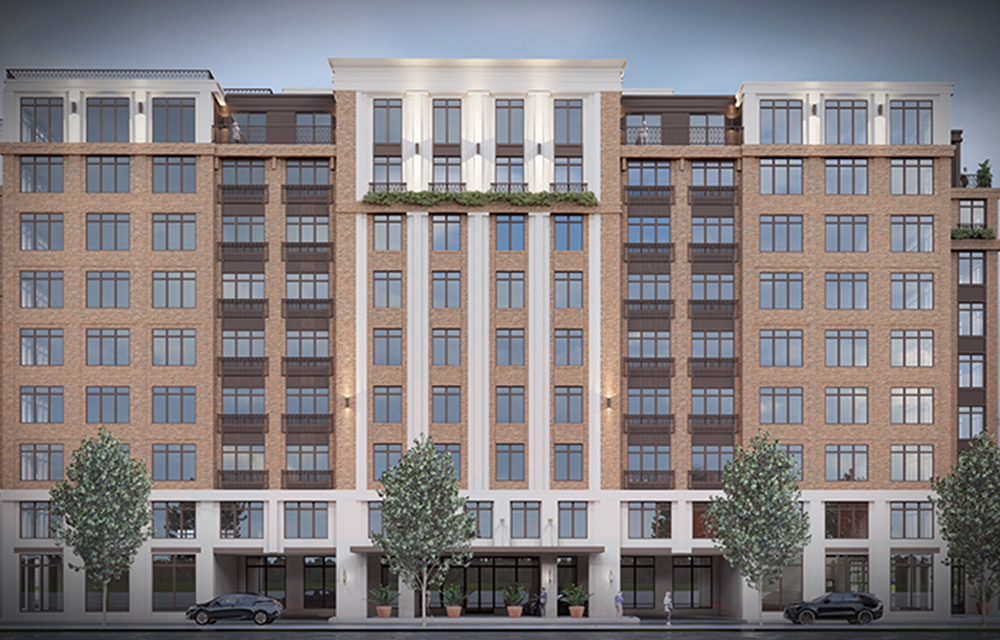
As part of its growing portfolio of New York City residential projects, GreenbergFarrow will transform the long-shuttered site of the Old Dutch Mustard Company into "80 Metropolitan," a six-story building with 114 lofts adjoined by nine three-story townhouses. The factory had been vacant for more than twenty years.
"80 Metropolitan will incorporate many forward-looking design elements," said Navid Maqami, AIA, NCARB, LEED, principal of architecture at GreenbergFarrow. "The design is inspired by the Williamsburg community's industrial history. 80 Metropolitan will be a chic and modern building that evokes the character of a neighborhood once dominated by factories and warehouses."
Located at the corner of Metropolitan and Wythe Aves., the building will be topped by 24 rooftop cabanas available for purchase by individual homeowners. The loft condominiums range in size from 529 s/f studios to 1,483 s/f three-bedroom units. The townhouses are more than 2,000 s/f, with three bedrooms, private backyards and second floor terraces.
Steiner expects 80 Metropolitan will be ready for occupancy in early 2009. Halstead Property's development division -- which is exclusively marketing the property -- has opened a sales office at 242 Wythe Ave., one block from the site.
Tags:
Spotlight Content
MORE FROM Spotlight Content

The commercial classroom: 1031 tax-deferred exchanges - by Edwad Smith Jr.
The sale of real estate may trigger capital gains taxes on the net profits of that sale. These taxes may be deferred by participating in a 1031 tax exchange, in essence, by purchasing property(s) to replace the


.png)

 (2).gif)

Columns and Thought Leadership

CRE Guide Featured Company: Merritt Environmental Consulting Corp.
Merritt Environmental Consulting Corp. (MECC) was established in June of 2009 after being part of a larger engineering firm for almost 20 years. The focus of the company is to assist lending institutions, attorneys, real estate investors, and property owners with environmental concerns. Today, MECC has offices in New York, Florida, and Vermont and has grown into a regional consulting firm serving clients along the East Coast.

From vacancy to vitality: How adaptive reuse is reshaping Long Island’s CRE landscape - by Andrea Tsoukalas Curto
Adaptive reuse has become one of the most important conversations in commercial real estate today. Long Island has a large inventory of aging retail, office and industrial

2026 Developing Queens: Long Island Board of Realtors advances commercial growth and advocacy in Queens
The Long Island Board of Realtors (LIBOR) Commercial Network continues to play a key role in advancing opportunities and strengthening the commercial real estate landscape across Queens. Through targeted programming and global outreach

2026 Developing Long Island: ERG Commercial Real Estate launches its new Retail Leasing division
North Hempstead, NY ERG Retail Leasing is the dedicated leasing division of ERG Commercial Real Estate, an established full-service commercial real estate brokerage for over 35 years.