
The Great Realignment, part III: CRE faces the maturity wall into Q4 2026 - by Michael Packman

An update to our May and Q3 2026 reports, focused on the September Fed rate increase, the commercial real estate debt maturity wall, and what it means for owners facing a near-term loan refinancing.
Our last two updates tracked the market firming on improving fundamentals even as financing costs stayed in question. That question is now answered, and not in the direction many borrowers hoped. The Fed raised rates in September, the 10-year Treasury sits near an 18-month high, and roughly $1 trillion in CRE loans mature this year alone. For owners facing a refinancing wall with no easy exit, the conversation is shifting from “when will this market turn” to “what do I do with this asset, now.”
Rates: A Hike, Not a Cut
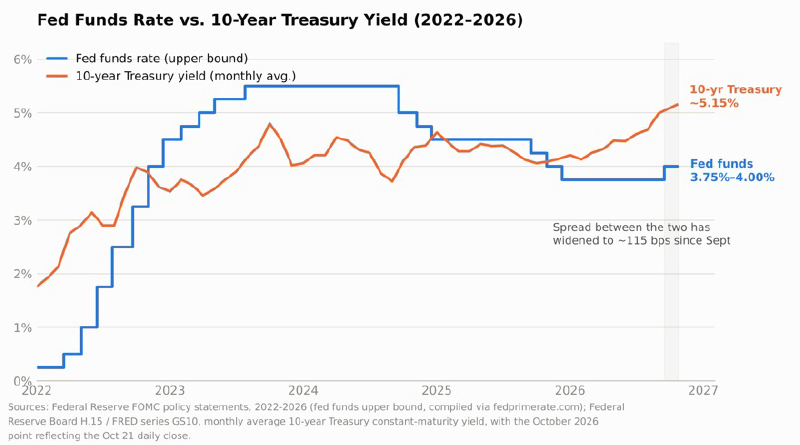
On September 16, the FOMC raised its target range a quarter point, to 3.75%–4%, unanimously (Federal Reserve). The Committee cited inflation still above its 2% goal despite “solid” growth, strong productivity, and resilient spending. The move reversed the hold-steady posture we described over the summer, and bonds reacted: the 10-year Treasury climbed to the 5.1%–5.3% range in October, its highest sustained level in roughly 18 months (Old Republic Title). For CRE borrowers, that’s the number that matters most — more than the Fed’s own benchmark.
The Debt Market: Confirming the Maturity Wall
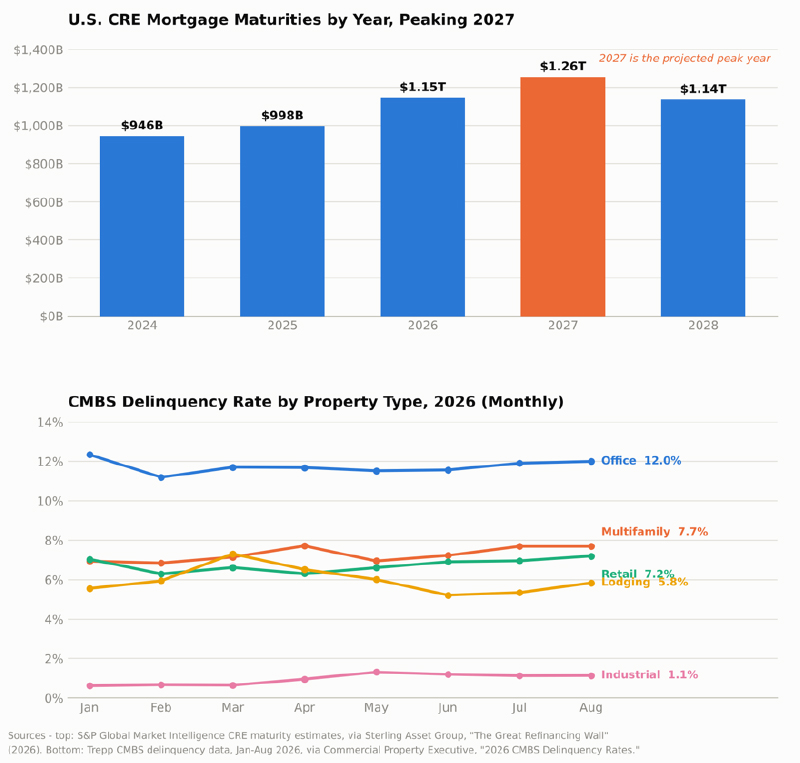
Yes, the wave is real. S&P Global estimates $1.148 trillion in CRE mortgages maturing in 2026, climbing to a $1.257 trillion peak in 2027; MBA’s narrower measure puts 2026 at $875 billion (Sterling Asset Group, CoStar). The core problem is a rate gap: loans originated in the mid-2020s at roughly 4.1%–4.7% are resetting against market rates near 6.5% and climbing (CoStar). Banks and thrifts hold the largest share of 2026 maturities, about $396 billion, concentrated outside the 25 largest institutions (Sterling Asset Group).
Not every sector is equally exposed. Office is the clear stress point — 83.7% of outstanding pre-2026 office CMBS loans are delinquent, a record 12.34% office CMBS delinquency rate (CoStar). Retail carries similar strain; multifamily and industrial are comparatively insulated, with sub-1% delinquency and continued agency-lender support (CoStar). The result, so far, is a slow sort rather than a crash: MSCI reports distressed sales up 26.4% year-over-year through September to $13.2 billion — still just 2.4% of total volume, as debt funds keep extending and modifying loans rather than forcing sales (MSCI, via The Real Deal). “There’s just an abundance of debt funds willing to work with people,” MSCI’s Jim Costello noted. Still, a CoStar-cited survey is blunt: nearly $1 trillion in maturities are “forcing decisions” this year, formal distress or not (Old Republic Title).
The Rest of the Market Keeps Moving
Underneath the financing stress, operating fundamentals are broadly healthy. CBRE’s Q3 property sales revenue rose 37% year-over-year, and CoStar projects at least $96 billion in Q3 volume across major asset classes, continuing double-digit annual growth (CBRE, Old Republic Title). Industrial remains the top performer; office leasing is quietly recovering toward pre-pandemic norms even as values stay pressured; and data center inventory is up 80% year-over-year, led by Texas, Virginia, and Georgia (Old Republic Title).
What This Means If You’re the One Refinancing
If you own an asset with a loan maturing into this environment, a forced sale is a real possibility — and if that property has appreciated since purchase, a sale can trigger a meaningful capital gains tax bill on top of an already difficult repricing. This is where it’s worth understanding your options, not just your exposure.
A 1031 exchange allows an investor selling real property held for investment or business use to defer capital gains tax by reinvesting the proceeds into “like-kind” replacement property, generally within a 45-day identification window and a 180-day closing window. For an owner who still wants to hold real estate but needs to exit a specific, maturity-pressured asset, a 1031 exchange can preserve capital that would otherwise go to taxes.
For investors who’ve had enough of active management — leasing, capital calls, and now loan workouts — it may be worth researching Delaware Statutory Trusts (DSTs) as a replacement property option. Since a 2004 IRS revenue ruling, fractional DST interests have qualified as like-kind property for 1031 purposes, letting an investor exchange into institutional-grade real estate with professional management and no landlord responsibilities (Eisner-Amper).
None of this is tax or legal advice — 1031 timelines and DST structures carry real restrictions and risks, and the right move depends on your specific basis, debt, and goals. If a maturity date is approaching, it’s worth that conversation with a qualified intermediary, CPA, or advisor sooner rather than later.
Primary Sources
• Federal Reserve: FOMC Statement (September 16, 2026)
• Federal Reserve Board: H.15 Selected Interest Rates / FRED Series GS10 (10-Year Treasury Yield)
• Old Republic Title: “Commercial Snapshot Q3 2026”
• Sterling Asset Group: “Commercial Real Estate Debt Maturities Through 2028: Navigating the CRE Refinancing Wall”
• CoStar: “Why Commercial Property Pros Say a Looming $1.26 Trillion Debt Wall Can Be Scaled”
• MSCI, via The Real Deal: “Distressed Commercial Sales Spiking This Year” (October 21, 2026)
• CBRE Group, Inc.: Q3 2026 Financial Results
• Trepp, via Commercial Property Executive: “2026 CMBS Delinquency Rates”
Michael Packman is the founder and CEO of Keystone National Properties (KNPRE), Jericho, N.Y.