
C&W report finds vacancy edges lower and positive absorption spreads across Tri-State industrial market
New York, NY Industrial demand across the New York, New Jersey and Pennsylvania corridor accelerated sharply during the first half of 2026, offering the clearest evidence yet that one of the nation’s largest logistics markets is beginning to move toward greater balance following several years of rapid supply growth, according to a new report from Cushman & Wakefield.
New leasing activity increased 35.6% year over year to 36.5 million s/f, the second-highest first-half total since 2021. The increase in demand helped push the regional vacancy rate down 10 basis points year over year to 8.5%, while the corridor recorded 16.1 million s/f of positive net absorption through June.
The improvement comes after a historic expansion of the region’s industrial footprint. Inventory across the corridor has increased 22.3% over the past five years, surpassing 1.5 billion s/f as more than 236.7 million s/f of new space was delivered.
“After several years when new supply was reshaping market fundamentals, we’re now seeing demand accelerate enough to begin changing that equation,” said Dimitri Mastrogiannis, senior research analyst, Long Island/NYC Outer Boroughs at Cushman & Wakefield. “The important signal at midyear isn’t simply that leasing increased.
It’s that stronger demand is translating into occupancy gains across nearly the entire corridor, even as individual markets remain at very different points in their recovery.”
Pennsylvania Emerges as Regional Demand Engine
The PA I-81/I-78 Corridor recorded 11.1 msf of new leasing during the first half of the year, already exceeding 80% of its full-year 2025 total. The market also generated 7.5 msf of net absorption, the highest among the markets included in the report.
At the same time, Pennsylvania remains a key test of the region’s ability to absorb additional supply. The PA I-81/I-78 Corridor accounts for 14.1 msf, or 45.5%, of the 31.1 msf currently under construction across the Tri-State region.
“Pennsylvania is demonstrating just how quickly the demand picture can change when occupiers return to the market at scale,” said Ryan Hull, Senior Research Analyst, Pennsylvania/Southern New Jersey at Cushman & Wakefield. “The I-81/I-78 Corridor is absorbing significant space while maintaining a substantial development pipeline. The second half will tell us a lot about how effectively that demand can keep pace as additional supply comes online.”
New Jersey Shows Signs of Normalization
Demand also strengthened across New Jersey, particularly along the state’s major distribution corridors.
Central New Jersey recorded 9.9 msf of new leasing and 3.3 msf of positive net absorption during the first half. New space accounted for 81.6% of total leasing volume, while the Exit 8A submarket recorded more than 1.0 msf of leasing for a second consecutive quarter, an early sign of improvement following two years of occupancy challenges.
Northern New Jersey recorded 6.1 msf of leasing and nearly 974,000 square feet of positive absorption. Vacancy remained elevated at 9.3%, however, as occupancy gains were not yet sufficient to offset recent deliveries, increasing competition among landlords and keeping concessions prevalent.
“We are beginning to see the New Jersey market work through the supply added over the past several years, but the recovery isn’t uniform,” said Felix Soto, Research Manager, New Jersey at Cushman & Wakefield. “Tenants have more options and landlords are competing for demand, but the return of positive absorption and sustained leasing activity are important steps toward a healthier supply-demand balance.”
Southern New Jersey provided another sign of that shift. Strong leasing combined with a stabilizing construction pipeline helped lower vacancy by 140 basis points from year-end 2025 to 10.4%. The market recorded 3.2 msf of new leasing and 2.4 msf of positive absorption through midyear.
New York Performance Diverges
Conditions across New York remained more varied.
Long Island recorded 2.3 msf of new leasing during the first half, more than double the 1.1 msf recorded during the same period in 2025. Slower new supply and stronger tenant demand contributed to positive absorption and a decline in vacancy during the second quarter.
The New York City Outer Boroughs remained the notable exception to the broader regional trend. The market recorded negative 460,853 square feet of net absorption during the first half as new space continued to enter the market, pushing vacancy to 6.7%. Average asking rents remained the highest among the markets tracked in the report at $28.12 per square foot.
Supply Remains the Test
Despite stronger demand, the regional supply picture remains a critical factor heading into the second half of 2026.
Approximately 31.1 msf remains under construction across 91 projects, compared with 28.2 msf at midyear 2025. Six of the eight markets tracked in the report have preleasing rates below 50%, leaving the pace at which newly delivered space is absorbed as a key measure of the market’s continued normalization.
The longer-term development pipeline has moderated considerably from its pandemic-era peak. Approximately
48.4 msf of projects broke ground in 2022, compared with 31.9 msf in 2023, 22.5 msf in 2024 and 29.8 msf in 2025. Another 14.9 msf of construction starts were recorded during the first half of 2026.
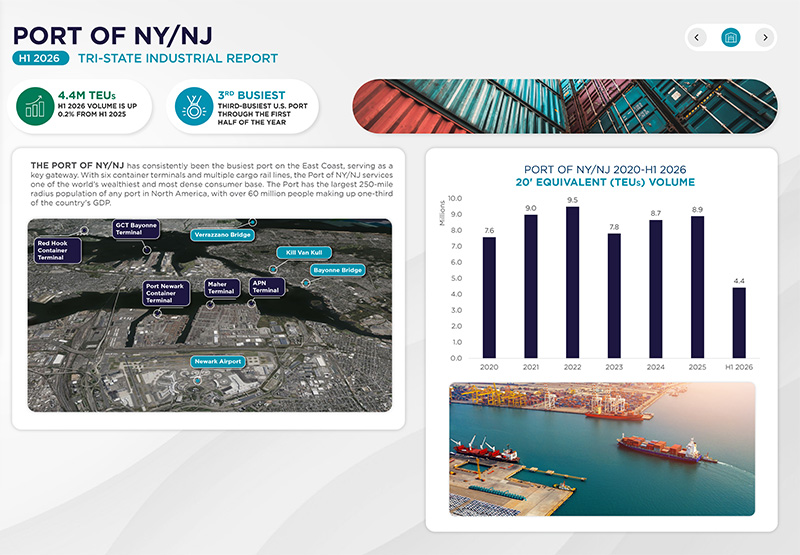
The corridor’s underlying logistics advantages remain substantial. Approximately 60 million people live within a five-hour drive of the Port of New York and New Jersey, while the region encompasses some of the country’s largest population centers and consumer markets. The Port handled 4.4 million TEUs during the first half of 2026, up 0.2% from the same period last year.
Looking ahead, Cushman & Wakefield expects demand momentum to support additional occupancy growth, while rental rates remain relatively stable as landlords continue to use concessions to compete for tenants. The firm’s forecast calls for average annual rental growth of approximately 2.5% across select Tri-State markets from year-end 2026 through 2028.
The Cushman & Wakefield H1 2026 Tri-State Industrial Corridor Report analyzes industrial conditions across Long Island, the New York City Outer Boroughs, Lower Hudson Valley, Northern New Jersey, Central New Jersey, Southern New Jersey, Philadelphia and the PA I-81/I-78 Corridor.