
Alpha Realty’s quarterly market reports – Q2
NYC Multifamily Market Overview – Q2 2026
New York City’s multifamily market remained active in Q2 2026, recording 304 transactions, an increase of 10.5% quarter-over-quarter and 2.4% year-over-year. Total dollar volume reached $1.52 billion, down 12.7% from Q1 and 2.2% from Q2 2025, while 6,242 units traded, representing a 19.2% quarterly increase. The quarter’s higher transaction count, combined with a lower average deal size of $5.9 million, indicates that investor demand remains strong but has shifted toward smaller and more moderately priced properties. Large multifamily buildings with 20 or more units generated 112 transactions, up 24.4% quarter-over-quarter, while the 10–19-unit segment posted the strongest dollar-volume growth, reaching $289.8 million, an increase of 51.8% year-over-year. At the borough level, Manhattan led the city in dollar volume, Brooklyn remained the most active market by transaction count, the Bronx experienced a substantial quarterly rebound, and Queens saw activity concentrate primarily in smaller properties.
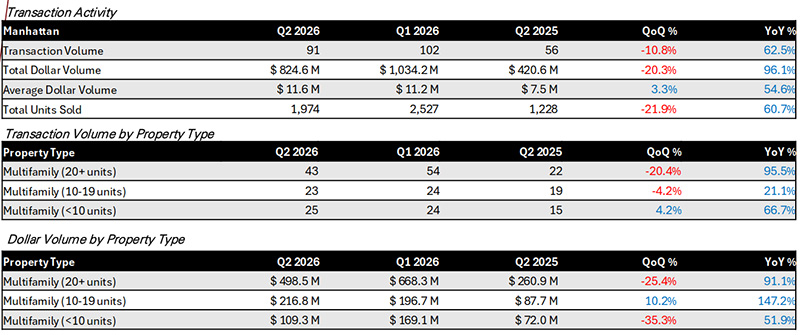
Manhattan
Manhattan remained the city’s largest multifamily market by dollar volume, recording 91 transactions totaling $824.6 million. Although activity declined from Q1’s exceptionally strong pace, transaction volume remained 62.5% above Q2 2025, while dollar volume increased 96.1% year-over-year. The average transaction size rose to $11.6 million, up 54.6% from the prior year, demonstrating continued demand for larger and higher-quality Manhattan assets. Properties with 20 or more units accounted for 43 transactions and $498.5 million in dollar volume, while the 10–19-unit segment posted particularly strong growth, with dollar volume increasing 147.2% year-over-year. Smaller properties also remained highly active, with transactions involving fewer than 10 units rising 66.7% year-over-year, signaling continued participation from private investors across Manhattan’s multifamily market.
Brooklyn
Brooklyn remained New York City’s most active borough by transaction count, with 116 multifamily sales in Q2 2026, an increase of 10.5% from the previous quarter. Total dollar volume reached $411.8 million, while 1,456 units traded, representing a 20.3% quarterly increase. The average transaction size declined to $3.8 million, reflecting a continued shift toward smaller and more affordable properties. Buildings with fewer than 10 units accounted for 85 of the borough’s 116 transactions, confirming that smaller walk-up assets remain Brooklyn’s most liquid multifamily segment. Activity in larger properties also improved. Transactions involving buildings with 20 or more units increased 42.9% both quarter-over-quarter and year-over-year, while the 10–19-unit segment recorded a 37.5% quarterly increase in transactions and a 40.9% increase in dollar volume.
Queens
Queens experienced a slowdown during Q2 2026, recording 34 transactions totaling $70 million. Transaction volume declined 24.4% quarter-over-quarter, while dollar volume fell 54.3%, largely due to reduced activity among larger institutional assets. Buildings with 20 or more units accounted for only four transactions, compared with 10 during the prior quarter. In contrast, smaller properties remained considerably more resilient, with buildings containing fewer than 10 units accounting for 27 of the borough’s 34 transactions. Dollar volume for smaller properties reached $43.5 million, an increase of 11.8% year-over-year, demonstrating sustained private-investor interest despite the broader decline. Transit-oriented neighborhoods such as Astoria and Ridgewood continue to attract investors seeking smaller, value-focused opportunities.
Bronx
The Bronx recorded the strongest quarter-over-quarter recovery of any borough, with transaction volume increasing to 63 sales, up 173.9% from Q1. Total dollar volume surged to $216.5 million, representing a 289.6% quarterly increase, while the number of units sold rose to 2,462. Large properties led the borough’s recovery. Buildings with 20 or more units accounted for 45 transactions, up from only 12 in the previous quarter, while dollar volume in the segment increased to $179.9 million. The average Bronx transaction size rose to $4.2 million, an increase of 52.8% quarter-over-quarter. Although activity remained below the unusually strong levels recorded in Q2 2025, the quarter’s rebound indicates renewed investor interest, particularly in larger East Bronx multifamily properties.
Market Takeaways & Investor Outlook
The NYC multifamily market continued to demonstrate resilience in Q2 2026, with transaction activity rising despite elevated borrowing costs and ongoing policy uncertainty. Transaction volume increased 10.5% quarter-over-quarter, underscoring that investor demand remains healthy, although buyers are increasingly focused on smaller and more efficiently priced opportunities. Large-scale assets (20+ units) continued to attract institutional capital, while the 10–19-unit segment emerged as the strongest-performing category, posting more than 50% year-over-year growth in dollar volume. At the same time, the recent Rent Guidelines Board rent freeze and rising operating expenses continue to place pressure on rent-stabilized assets, reinforcing investor preference for free-market and Protected Tax Class multifamily properties that offer stronger long-term income growth and lower operating costs.
At the borough level, Manhattan dominated investment volume, accounting for more than half of all citywide dollar volume, while Brooklyn remained the most active market by transaction count, driven by consistent demand for smaller walk-up buildings. The Bronx delivered the strongest quarter-over-quarter recovery, fueled by renewed institutional interest in larger multifamily assets, whereas Queens shifted toward a private-investor-driven market, with activity concentrated in smaller buildings as larger acquisitions slowed. Looking ahead, the market remains well positioned for the second half of 2026, with improving capital markets, record rental fundamentals, and limited new multifamily supply expected to support continued investment activity for both institutional and private buyers.