
Manhattan in comparison to the world’s most expensive cities - by Joseph Aquino
New York has never been a bargain. As America’s financial capital and one of the world’s leading centers for finance, media, fashion, entertainment, technology, and commercial real estate, high prices have long been part of its identity.
But there is a difference between being expensive and becoming unaffordable.
Recent international cost-of-living studies continue to rank Manhattan among the world’s most expensive places to live. According to Engel & Völkers, New York serves as the global benchmark with a Rent Index of 100. Every other city’s rental market is measured against it. The index does not mean New Yorkers spend 100 percent of their income on rent. Rather, it establishes New York as the international benchmark against which all other cities are compared.
The table below compares Manhattan with ten of the world’s leading global cities, illustrating how dramatically rental costs can vary while confirming New York’s position at the top.
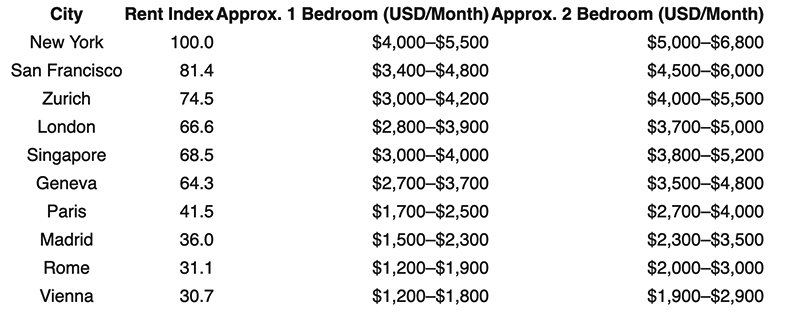
Source: Engel & Völkers, using Numbeo’s 2026 Mid-Year Cost of Living and Rent Indices.
While these figures provide an excellent international comparison, I believe Manhattan’s published rental averages remain conservative. Based on my more than forty years in New York commercial real estate—and as a Manhattan renter myself—I believe asking rents in many desirable neighborhoods are generally higher than many published averages. Today, one-bedroom apartments commonly rent for between $4,000 and $5,500 per month, while two-bedroom apartments typically range from $5,000 to $6,800. Luxury buildings often command substantially more.
The numbers tell the story.
For many working New Yorkers, housing has moved beyond expensive — it has become unaffordable.
The question is no longer whether New York remains one of the world’s most desirable cities. It clearly does.
Housing affordability is not simply a social issue — it is an economic one.
When employers struggle to recruit workers because employees cannot afford to live nearby, businesses suffer. When families devote an ever-larger share of their income to rent, they have less money to spend at neighborhood restaurants, retail stores, entertainment venues, and small businesses. The ripple effects are felt throughout the city’s economy.
History also offers an important lesson. When the cost of living rises far beyond what ordinary working people can afford, pressure inevitably grows for greater government intervention. Whether one agrees with those policies or not, the reason is understandable. If people believe the marketplace no longer works for them, they naturally begin searching for alternatives.
New York did not become one of the world’s greatest cities by excluding opportunity. It became great because generations of immigrants, entrepreneurs, artists, workers, teachers, and dreamers believed they could build a better life through hard work and determination.
That promise should not disappear because the middle class can no longer afford a place to live.
Protecting housing affordability is not simply good social policy.
It is good economic policy.
Most importantly, it is essential if New York is to remain a city where the middle class can still live, work, raise a family, and pursue the American Dream.
Landlords have long fought rent controls of every kind, often tooth and nail. Yet the global comparison of rental costs tells a story of its own: many of the world’s major cities have found ways to make housing significantly more affordable than Manhattan.
Disclosure:
Rental index data are derived from Engel & Völkers’ analysis of Numbeo’s 2026 Mid-Year Cost of Living and Rent Indices. Approximate rental figures are estimates based on prevailing market conditions and are provided for illustrative purposes only. Actual asking rents and lease terms vary by location, building, apartment size, condition, and market fluctuations. The commentary and opinions expressed are solely those of the author and do not necessarily reflect the views of any organization or data provider.
Joseph Aquino is president of JAACRES, Manhattan, N.Y.