
Landow and Landow Architects designs first mass timber building for SUNY Maritime College
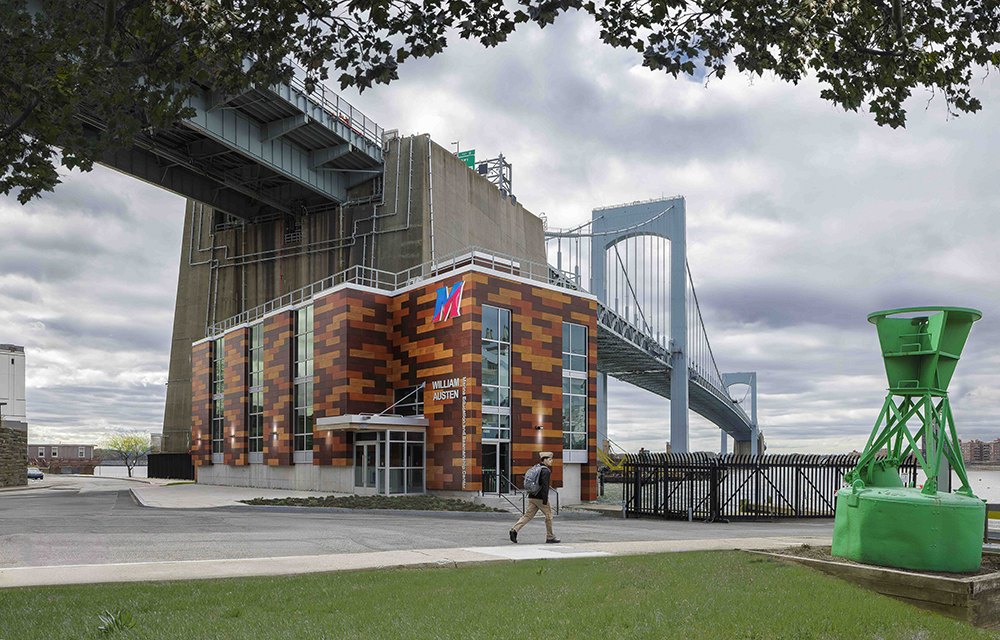
Bronx, NY Landow and Landow Architects has completed the William Austen Marine Education and Seamanship Center at SUNY Maritime College, a groundbreaking facility that is both an academic hub and a milestone in sustainable design.
Situated at the entrance to the college’s East River pier, home to the training ship Empire State and directly below the Throgs Neck Bridge, the center is the first building in the entire SUNY system to utilize a sustainable mass timber structural system. With this material, the design significantly reduced the amount of embodied carbon found in more commonly used concrete and steel. All structural elements are intentionally left exposed, offering students a clear view of how the innovative material functions. The building is also fully electric, underscoring SUNY Maritime’s commitment to energy efficiency and sustainability.
The first floor of the center, elevated a half-story above grade in response to FEMA floodplain requirements, contains a state-of-the-art wet science laboratory, creating a dynamic hands-on learning environment for students. Above, the second floor provides classroom space for the college’s Marine Transportation Department. The design takes full advantage of the waterfront setting, with views of the Throgs Neck Bridge, the Empire State, and the New York City skyline, reinforcing the connection between the academic program and the maritime environment.
The project was led by SUNY Maritime College as owner, with Landow and Landow Architects serving as architects and interior designers. The design and construction team included Severud Associates as structural engineer, Setty & Associates as MEP engineer, and LaBella Associates as civil engineer. CANY acted as building envelope consultant, AB Consulting provided vertical transportation consulting, and Paul Petretti served as surveyor. Construction was carried out by AWL Industries as general contractor. Together, this collaborative team brought the William Austen Marine Education and Seamanship Center to life, a model of sustainable innovation, technical ingenuity, and academic advancement that reflects SUNY Maritime College’s mission to prepare the next generation of maritime professionals.
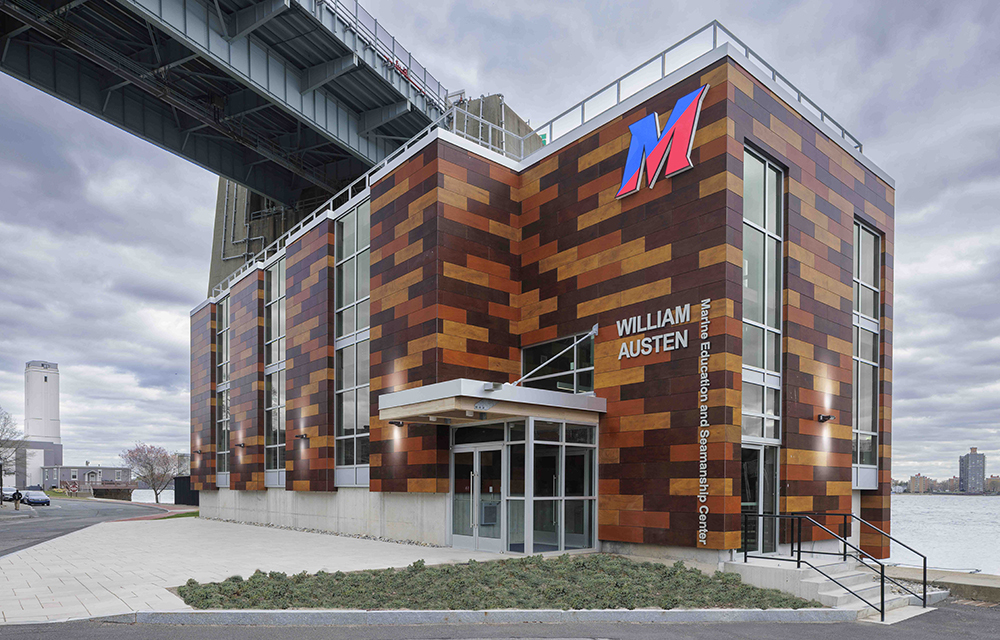
The exterior of the building combines glazing with an engineered wood panel rainscreen, emphasizing both transparency and the warmth of natural materials. Inside, all utilities and building systems are left visible, allowing engineering students to study the building’s functional components. The result is an academic facility that not only serves its educational mission but is itself a teaching tool.
“This project represents a true milestone for SUNY Maritime and the entire SUNY system,” said Glen Landow, AIA NCARB LEED AP, partner at Landow and Landow Architects and lead designer of the building. “By integrating mass timber, advanced laboratory systems, and sustainable design strategies, as promoted by the college’s forward-thinking administration and facilities staff, we created a building that is not only environmentally responsible but also serves as a living classroom, teaching students about systems and innovation in real time.”
Originally envisioned as a single-story laboratory and boathouse built above the pier, it was relocated to a parking lot at the pier entrance to satisfy New York City environmental agencies. The new site presented challenges, including its position a half story below the FEMA floodplain, and a foundation that bridges over a buried steam tunnel running directly beneath the building footprint, while avoiding the buried support buttresses of a 200-year-old seawall above which it cantilevers.
Initially considered for prefabrication, the building was ultimately constructed fully on-site. When relocated, the college’s president seized the opportunity to expand the program, adding a second floor with maximized glazing to take advantage of the waterfront setting. A detailed energy analysis shaped the final design, integrating both glass and solid elements to balance views and performance.