
H2M offers virtual reality services
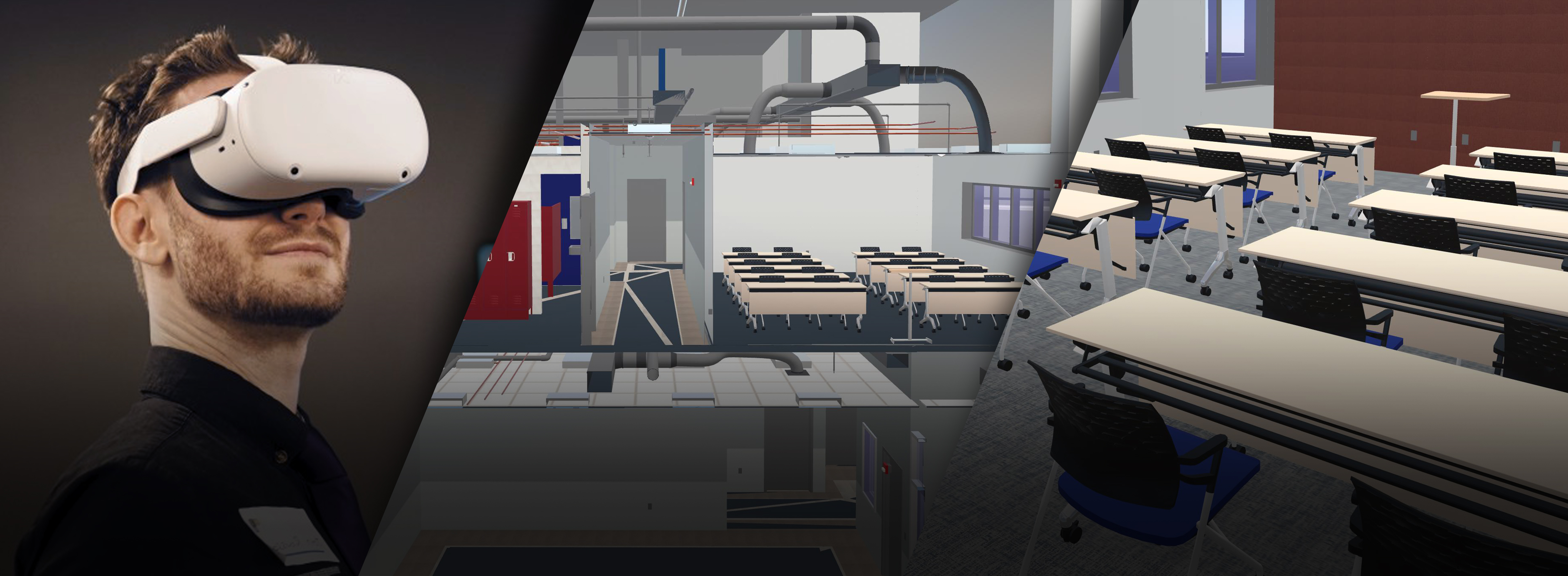

H2M architects + engineers (H2M) now offers virtual reality (VR) services to their clients. These services include VR modeling of designed spaces that enable clients to “walk” through their buildings long before construction begins. VR technology is a useful visualization tool for anyone unfamiliar with the art of reading top-down plans and other construction documents.
John Rousso, project designer at H2M, is taking the lead with this new company offering. As a long-time enthusiast of virtual reality, Rousso is dedicated to mending the potential disconnect between “what our clients are expecting in project design versus our design understanding.” Rousso went on to explain, “I love when clients say, ‘Oh, that’s what that looks like!’ It’s useful when clients can point out when windows, finishes, or even entire rooms don’t match their vision.” Rousso estimates that using VR technology to realign client vision with project plans has already saved certain projects tens of thousands of dollars and countless construction days by avoiding changes.
H2M’s president and CEO, Richard Humann, P.E., is excited to start offering virtual reality services. “It’s a whole new world of opportunity in client engagement during design,” Humann said. “Virtual reality technology opens the door to a new way of more efficiently presenting our design work, improving project understanding, and building stronger relationships with our clients.”
VR technology for architectural design is fully built out and ready to be put to work. VR models are built to-scale and are one-to-one representations of exactly how the end product will look and feel. If the design calls for a 20-foot-high ceiling, looking up while wearing the VR headset will make the ceiling appear 20-feet-away. Rather than physically walking though the space, movement is controlled with a pair of handheld controllers. H2M feels that the opportunity to identify and resolve client concerns during design instead of construction is “priceless.”
For users and clients who haven’t developed their VR “sea legs” yet, Rousso offers to navigate through the space for them and projects what he sees onto a large monitor. Clients can then see a three-dimensional perspective of what he sees as Rousso explores each room of the model. Any time a client points out design details that are different from their vision, Rousso uses a voice-to-text feature to immediately record the difference within the VR space. Afterwards, the design team can update the design documents based on the client’s direct comments.
“It’s exciting to see VR technology applied to architecture,” Rousso said. “The better we can engage with our clients in a collaborative design vision, the better the entire project execution process.”