


 (2).gif)
News:
Spotlight Content
Posted: May 17, 2016
Kammas of Skyline Risk Management lobbies U.S. lawmakers on flood insurance protection
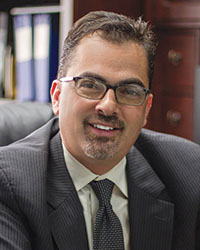 Anthony Kammas, Skyline Risk Management
New York, NY Real estate owners in New York and around the country may be in line for much needed relief in obtaining lender required flood insurance, according to Anthony Kammas, partner at New York-based Skyline Risk Management, a major construction insurance agency.
Kammas, secretary-elect of the Professional Insurance Association (PIA) New York Chapter, recently spent two days on Capitol Hill meeting with U.S. Senator Chuck Schumer of New York and other key legislators to urge elected officials to support the House of Representative Bill (HR2901) and Senate Bill (#1679) which would open the flood market to private carriers.
“The federal government currently provides flood insurance through the National Flood Insurance Program (NFIP), and private carriers now want to enter this market,” said Kammas, who is currently a board member of the PIA of New York and chair of the PIA’s governmental affairs committee. “The goal is to provide private flood market insurance and competition so the government is the carrier of last resort. That will help with the pricing of such coverage.”
According to Kammas, the government flood program is reauthorized annually, but the PIA wants to get it authorized for 10 years so that there is a sense of stability within the marketplace. The House vote is set for this week and the U.S. Senate Banking Committee is set to debate the bill for consideration this summer.
“Senator Schumer is very supportive of flood insurance and we are waiting to see what he and U.S. senator Robert Menendez of New Jersey are going to do,” said Kammas, who said the U.S. government lost nearly $24 billion because it set flood insurance premiums too low and did not collect enough premium to cover claims.
“Now with new actuarial rates, private carriers see some money can be made,” said Kammas, who explained that even if the bill passes, the NFIP will still be able to offer flood insurance, but they will no longer be the primary provider of flood insurance.
Kammas is a partner at Skyline Risk Management, a New York-based insurance company that specializes in construction and real estate insurance. During 2015, new construction costs for residential projects grew to an all time high of $18-billion, almost double from the $10-billion in 2014 of which Skyline procured insurance for almost $1-billion of that total cost in 2015.
The company is licensed in nine states and territories including New York, Connecticut, New Jersey, Pennsylvania, Maryland, Delaware, the District of Columbia, Virginia and Florida.
On his recent trip to D.C., Kammas joined with hundreds of his fellow agents from across the country as part of the National Association of Professional Insurance Agents’ 2016 Federal Legislative Summit. “PIA is an aggressive, activist organization that is never afraid to speak up and speak out on behalf of our members and clients,” said Kammas.
Tags:
Spotlight Content
MORE FROM Spotlight Content

NYREJ's 2026 Developing Long Island Spotlight is here!
This spotlight showcases projects completed and currently under construction across Long Island as well as highlights improvements made to the region through Industrial and Economic Development Agencies and BIDs.



.png)

 (2).gif)

Columns and Thought Leadership

CRE Guide Featured Company: Merritt Environmental Consulting Corp.
Merritt Environmental Consulting Corp. (MECC) was established in June of 2009 after being part of a larger engineering firm for almost 20 years. The focus of the company is to assist lending institutions, attorneys, real estate investors, and property owners with environmental concerns. Today, MECC has offices in New York, Florida, and Vermont and has grown into a regional consulting firm serving clients along the East Coast.

2026 Developing Queens: Long Island Board of Realtors advances commercial growth and advocacy in Queens
The Long Island Board of Realtors (LIBOR) Commercial Network continues to play a key role in advancing opportunities and strengthening the commercial real estate landscape across Queens. Through targeted programming and global outreach

From vacancy to vitality: How adaptive reuse is reshaping Long Island’s CRE landscape - by Andrea Tsoukalas Curto
Adaptive reuse has become one of the most important conversations in commercial real estate today. Long Island has a large inventory of aging retail, office and industrial

Properly serving a lien law Section 59 Demand - by Bret McCabe
Many attorneys operating within the construction space are familiar with the provisions of New York Lien Law, which allow for the discharge of a Mechanic’s Lien in the event the lienor does not commence an action to enforce following the service of a “Section 59 Demand”.