



Self storage has long been a suburban story. Across America largest 100 metros, 59% of the inventory built over the past decade sits outside city cores, largely preserving the ratio of the total existing inventory.
Yet within that national picture, 41 of the top 100 largest metros delivered the majority of their new supply in urban areas over the past decade, driven by city-core residential growth, shifting demographics and the economics of urban infill.
We looked at both sides of that divide — metros where suburban development dominates and why, and where urban construction has taken hold.
Suburban self storage dominates across large, fast-growing metros
Cheaper land, easier permits and larger families with complex storage needs have kept suburbs the default destination for most of the country’s new self storage. The metros where that pattern is most pronounced tend to fall into two categories: large, fast-growing markets where suburban residential expansion has outpaced everything else, and historic metros where land for new commercial construction is almost inexistent in the city cores.
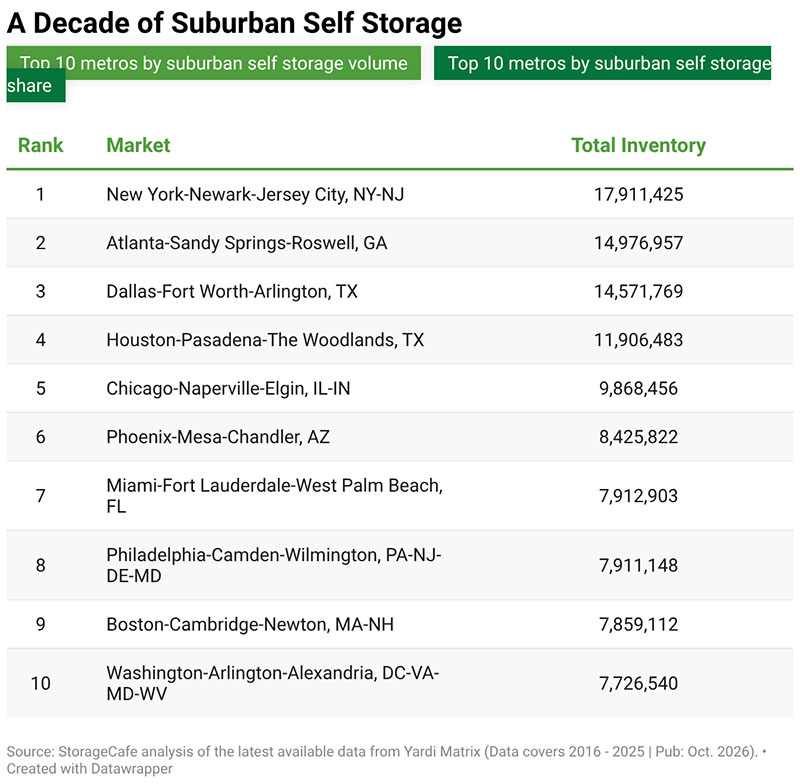
Large, fast growing metros lead in suburban volume
The metros delivering the most suburban self storage by volume are predictably the country’s largest and fastest-growing.
New York-Newark-Jersey City, NY-NJ, delivered 25 million s/f of new self storage over the past decade, the largest volume of any metro in the country, with 69% going to the suburbs. That distribution partly reflects deliberate regulatory choices: New York City has actively restricted self storage development in its industrial business zones since 2017, steering development toward suburban New Jersey and the broader suburban ring where land is more available and the process of getting new projects approved more straightforward.
Close to 15 million s/f of suburban self storage was delivered across the Atlanta-Sandy Springs-Roswell, GA, metro area over the past decade, much of it tracking the explosive residential growth that has pushed Atlanta’s footprint across a sprawling network of master-planned communities and highway-linked suburbs stretching from Cherokee County in the north to Henry County in the south
Dallas-Fort Worth-Arlington, TX, managed to add around 14,5 million s/f of suburban self storage during the past decade. However, it also stands out as the most balanced large metro in the ranking, with its total inventory split almost evenly between urban and suburban. The current pipeline, however, points firmly outward, with 75% of the 2.9 million s/f planned or under construction in suburban areas. Dallas-Fort Worth continues to expand into new suburban employment and housing nodes, where larger homes and steady household accumulation drive storage demand, and developers are following that growth.
Chicago-Naperville-Elgin, IL-IN, saw close to 10 million s/f of suburban self storage over the past decade against 3.2 million urban, a gap that reflects both the scale of the metro’s suburban residential footprint and a regulatory environment that has grown increasingly restrictive for urban development. In May 2025, the Chicago City Council banned self storage in most business, commercial, and downtown zoning districts, a move that will likely widen that urban-suburban divide further in the decade ahead.
Phoenix-Mesa-Chandler, AZ, delivered a total of 15 million s/f of storage space, with suburban areas absorbing the majority, a reflection of the scale of residential growth in communities like Gilbert, Chandler and Surprise that continue to draw families outward.
Land-constrained metros build almost exclusively suburban
Boston-Cambridge-Newton, MA-NH, saw almost exclusively suburban new construction over the past decade, with 99% of its 8 million s/f delivered outside city cores. Despite a dense, renter-heavy urban core, new self storage there has long been constrained by high land costs, zoning restrictions and a scarcity of developable urban parcels, pushing most new supply to the suburban ring.
In Detroit-Warren-Dearborn, MI, 95% the decade’s 6.5 million s/f of self storage deliveries went to suburbs. Here, a prolonged period of urban population loss has left a fragmented city core where demand is thin and developer interest limited. Growth and storage development has followed residents to Oakland, Macomb and western Wayne County suburbs.
Riverside-San Bernardino-Ontario, CA, is the Inland Empire: a metro whose identity is fundamentally suburban, built around affordable land, a massive logistics economy, and families priced out of coastal Los Angeles. The local self storage landscape reflects that geography directly, with 89% of the decade’s new construction happening in the suburbs.
Where urban self storage is taking hold
Building urban self storage requires a dense renter population, developable land that hasn’t been priced out of reach and a local market with room to grow. Gen Z’s pull toward dense, amenity-rich cities has been creating exactly that demand: city apartments are smaller, roommates are common and personal storage space is at a premium.
We looked at America’s 100 largest metro areas by the share of new self storage construction delivered in urban areas over the past decade — and 42 of them built 50% or more of their new inventory in urban cores.
Where opportunities exist, developers pursue urban self storage development on two fronts: adaptive reuse, converting vacant offices, warehouses, and retail spaces into modern storage facilities, and ground-up construction on the infill parcels that residential developers pass over. In the right markets, the economics work.
Mid-size metros lead in urban share of new construction
The metros where urban self storage construction is prevalent are mostly second-tier ones, with just two of the top 10 exceeding two million residents. These are places where downtown cores are actively attracting new residents and investment, and where land remains accessible enough to build.
Where people downsize or trade suburban square footage for urban convenience, storage demand follows. Sun Belt cities, where rapid in-migration has delivered the renter-heavy, apartment-dense urban population that makes urban self storage not just viable, but essential.
1. Las Vegas-Henderson-North Las Vegas
Over the past decade, 96% of all new self storage delivered in the Las Vegas metro area (6.4 million s/f) landed in urban areas. The entire current pipeline follows the same pattern: every square foot planned or under construction is urban.
The logic is rooted in land economics. Central Las Vegas carries a long-standing inventory of underused commercial parcels and surface lots along its mid-century arterial grid — sites that residential developers routinely pass over as too small or irregularly shaped, but that work well for storage. Suburban communities in the metro area, meanwhile, face intense competition from residential and big-box retail for every available parcel, making urban infill the more accessible and often more economical path for storage developers. In a metro built almost entirely without basements, where apartment living is the norm and units trend small, the demand side is equally clear.
2. Colorado Springs, CO
Colorado Springs ranks second nationally, with 89% of its new self storage — over 2.1 million s/f — delivered in urban areas over the past decade. The pipeline points in the same direction: 91% of planned and under construction space is urban.
The backdrop is a city in the middle of a sustained downtown revival(opens in new tab), with new apartment projects reshaping the urban core and drawing a growing number of residents into city living. Many of them are outdoor enthusiasts navigating the storage demands of skiing, camping, climbing, and cycling gear in a city defined by its proximity to the Rockies — creating exactly the kind of overflow storage demand that urban facilities are positioned to serve.
3. Wichita, KS
Wichita delivered close to one million s/f of urban self storage over the past decade — 86% of all new construction in the metro. Nearly a third of the city’s entire urban storage inventory has come online in that same period, a sign of how much ground the market has covered in a relatively short time.
The driving force is a city that has been reinventing its downtown(opens in new tab) from the ground up — new residential projects, renovated historic buildings, and a growing professional class choosing urban living over the suburban sprawl that long defined this metro area. For those residents trading square footage for location, self storage has become a natural extension of city life, filling the gap between compact apartment living and the belongings that come with it.
4. El Paso, TX
El Paso saw 85% of its new self storage, nearly 925,000 s/f, delivered in urban areas over the past decade, with planned and under construction projects tracking almost identically at 84% urban. The city’s position as a major cross-border trade hub, its young and growing population, and a downtown redevelopment push that has concentrated rental housing in the urban core all point in the same direction.
The off-base housing footprint of Fort Bliss — one of the largest Army installations in the country — adds further depth to urban demand, with military families clustered in northeast El Paso’s urban neighborhoods generating the kind of transitional, high-turnover storage demand that the sector knows well.
El Paso’s zoning framework makes urban development particularly accessible for storage operators: self storage is permitted by right not only across all commercial and industrial districts but also in all apartment zoning districts, which gives developers significant flexibility to locate facilities close to where urban renters actually live.
5. Cape Coral-Fort Myers, FL
Cape Coral-Fort Myers registered over 3 million s/f of urban self storage delivered over the past decade — 83% of all construction in the metro — with nearly half of Cape Coral’s entire urban inventory coming online since 2016. One of the fastest-growing metros in the country, it has absorbed a continuous wave of in-migration, with seasonal snowbird demand adding further pressure on storage capacity in the principal cities.
The regulatory environment has also shaped where development lands. Faced with managing rapid commercial growth, Cape Coral amended its land development code in 2024 to govern where and how new self storage facilities can be built, including a provision for mixed-use developments, channeling new builds toward established urban locations while preserving suburban commercial corridors for other uses. The pipeline’s gradual shift toward balance — 59% urban, 41% suburban — reflects a market adapting to those parameters as suburban population growth builds its own case for new supply.
6. San Antonio-New Braunfels, TX
San Antonio is the second metro in this ranking to surpass two million residents, after Las Vegas. About 82% of the self storage built here over the past decade (close to 6.4 million s/f) is located in urban areas, a concentration driven by a renter-heavy urban core and the housing demand generated by Lackland AFB and Fort Sam Houston, two of the country’s largest military installations, both embedded within the city.
The current pipeline tells a different story: 51% urban, 49% suburban — a near-even split that signals a market in transition. The I-35 corridor connecting San Antonio to Austin, passing through the fast-growing communities of Schertz, Cibolo, and New Braunfels, has emerged as one of Texas’ most active residential growth zones, generating a suburban renter base at a scale that now justifies standalone storage development. With the urban market well-supplied and suburban population accelerating, the next decade is unlikely to look much like the last.
7. Scranton-Wilkes Barre, PA
No less than 81% of the self storage built in the Scranton metro over the past decade is located in urban centers, a major reversal of the metro’s existing inventory, which is 62% suburban. In fact, 45% of all urban self storage in Scranton was built in just the past decade, pointing to a concentrated and recent shift in where development is happening.
Residential conversion of historic buildings across the metro area has brought more people living downtown than ever before, while the presence of multiple universities — including the University of Scranton, Marywood, King’s, and Wilkes — anchors a steady renter population in the urban core. Meanwhile, new residential construction across the suburban counties of Lackawanna and Luzerne has been on the back burner, leaving the suburban ring largely static while the urban cores have been the primary locus of new housing activity. Storage has followed that residential momentum inward.
8. Durham-Chapel Hill, NC
Durham-Chapel Hill ranks 8th, with 81% of its 1.8 million s/f of new self storage going to urban areas over the past decade and nearly half of the metro’s entire urban inventory delivered in that same window.
The Research Triangle’s gravitational pull explains much of it. Duke University and UNC-Chapel Hill together generate a large, constantly renewing population of students, researchers, and medical professionals who live in dense urban neighborhoods, move frequently, and rarely have space to spare. That combination of density and turnover is one of the most reliable demand profiles in the self storage sector. Chapel Hill’s zoning framework reinforces the urban concentration further: the town requires self storage to share a lot with other commercial or institutional uses(opens in new tab), which effectively steers new facilities toward established mixed-use areas rather than standalone suburban sites.
However, the pipeline is beginning to reflect broader shifts in where the Triangle is growing. With 51% of the 214,000 s/f currently planned or under construction pointing suburban, Chatham County to the southwest is emerging as a spillover destination and new residential approvals along the Chapel Hill-Durham border corridor are bringing housing — and eventually storage demand — to areas that were largely undeveloped a decade ago.
9. Tucson, AZ
In Tucson, 80% of the self storage built over the past decade, around 2 million s/f, was delivered in urban areas. The concentration reflects two anchors embedded in Tucson’s urban core: the University of Arizona, whose huge campus sits just blocks from downtown and drives a dense, high-turnover renter population across neighborhoods like Fourth Ave., West University, and the Congress St. corridor; and Davis-Monthan Air Force Base, which adds a military population with similar transient, renter-heavy housing patterns.
Even so, suburban storage is catching up from a low base: roughly 43% of all suburban inventory in the Tucson metro (511,000 s/f) was built over the past decade, reflecting the sustained residential expansion in Marana and Oro Valley. The current pipeline reinforces the urban dominance for now, with three quarters of planned and under-construction space in urban areas, but as the suburban population continues to grow, that ratio will likely narrow.
10. McAllen-Edinburg-Mission, TX
About 77% of all self storage built over the past decade in the McAllen-Edinburg-Mission metro, nearly 1.4 million s/f, was delivered in urban areas, compared to 400,000 s/f in the suburbs. Both urban and suburban populations grew substantially over the period, but the character of that growth differs in ways that directly shape storage demand.
The metro’s three principal cities form a dense corridor along the US-83 expressway, anchored by a young population with growing families and a rapidly expanding rental market. Urban renters in small apartments, without garages or overflow storage, generate structurally stronger demand for self storage than the metro’s suburban owner-occupied households. McAllen also overhauled its land development code in 2024 for the first time in 50 years, introducing mixed-use zoning and reducing parking requirements, making urban development more flexible and accessible for developers across commercial uses.
The current pipeline of 318,000 s/f maintains that two-thirds urban, one-third suburban split, suggesting the pattern is holding even as suburban communities like Tres Lagos and North McAllen see new residential development.
Northeastern metros, at the forefront of urban self storage inventory growth
A different picture emerges when looking at which metros have grown their urban self storage inventory the most over the past decade. Older Northeastern cities such as Providence, RI, Worcester, MA, New Haven, CT, Albany, NY, and Philadelphia, PA, where a recent wave of downtown residential investment has created new demand, expanded their urban inventories at a fast pace.
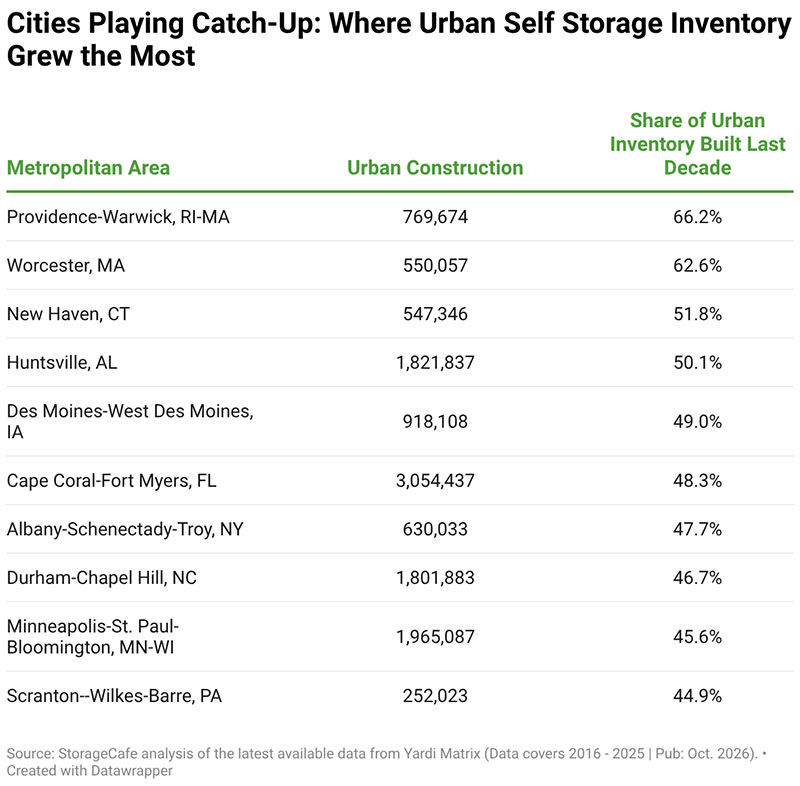
In Providence, RI, a sustained downtown revivalanchored in historic building conversion has transformed a largely vacant urban core into a thriving residential neighborhood, with about 66% of the metro’s existing urban self storage inventory delivered during the past decade alone.
Worcester, MA, has been experiencing a massive residential development boom(opens in new tab) that has reshaped its urban core. New Haven, CT, has maintained a similar trajectory, with a flurry of new construction in downtown and surrounding neighborhoods and a local push for urban housing(opens in new tab) that shows no signs of slowing. Self storage has followed in both cases: 63% and 52% respectively of each metro’s existing urban inventory was added over the past decade.
In Albany-Schenectady-Troy, NY, 48% of the metro’s urban inventory was delivered over the past decade, and the current pipeline suggests the trend is holding: two thirds of the 500,000 s/f planned or under construction are in urban areas.
Fast-growing Sun Belt cities building their urban cores from scratch are equally prominent in this ranking. Huntsville, AL, is the standout: population grew by over 20% over the past decade, with the urban core expanding faster than the suburbs, and half of the metro’s urban self storage inventory was built in that same period. Des Moines, IA, presents a similar scenario, with urban residential development driving self storage construction close to where people live. Almost half of its urban inventory is new, even as the overall market remains predominantly suburban.
Cape Coral-Fort Myers, FL, is another metro building its urban storage base rapidly from a low starting point. Over 3 million s/f of new space, or about 48% of its urban self storage, was delivered over the past decade, driven by sustained waves of in-migration. Hurricane Ian’s destruction in 2022 added a further layer of transitional demand in the final years of the period, accelerating rebuilding activity and concentrating storage needs in the principal cities. Durham-Chapel Hill, NC, similarly delivered 47% of its urban inventory during the decade — nearly 1.8 million s/f concentrated in the Research Triangle’s dense urban corridor.
Below you can see the urban vs suburban distribution of the self storage existing inventory and new construction in the country’s largest 100 metro areas.
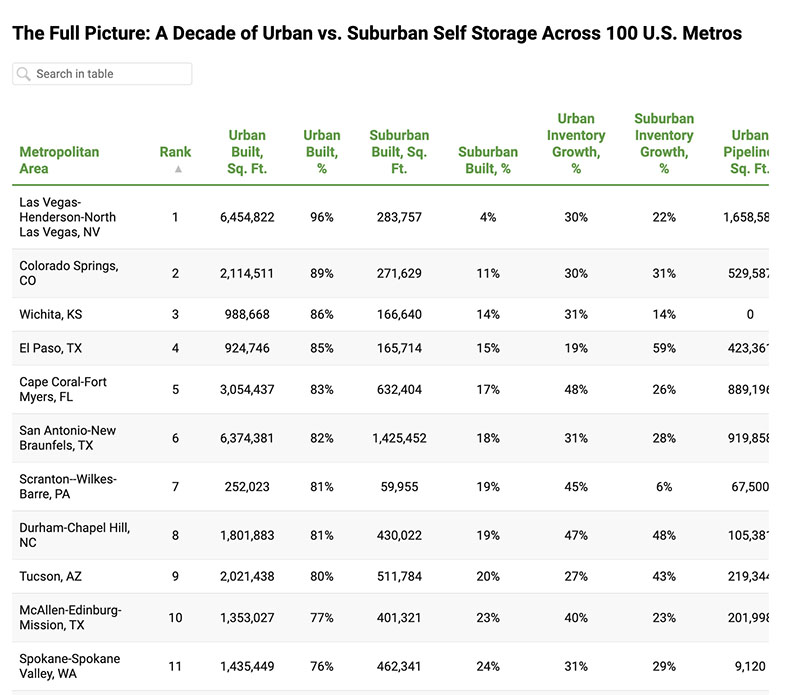
Self storage remains a predominantly suburban sector across America, but the urban pull manifests as well. In many metros across the country, self storage has become as much a part of city life as the apartment buildings it serves. For renters navigating tight apartments and urban lifestyles with no shortage of belongings, that means more options closer to home. For developers, it raises the question of where the next wave of self storage deliveries should occur.
Methodology
This analysis was conducted by StorageCafe, an online platform that provides nationwide listings of storage units.
We examined the 100 most populous U.S. metro areas and analyzed the distribution of self storage inventory between urban and suburban areas. Metro areas were ranked by the share of new self storage construction delivered in urban areas between 2016 and 2025. We also analyzed how much of each metro’s existing urban and suburban inventory was built during that same period.
For the purposes of this report, census tracts located within the principal cities of each metro area were classified as urban; all remaining tracts within the MSA were classified as suburban.
Population data is sourced from the U.S. Census Bureau.
Self storage construction and inventory data comes from Yardi Matrix, StorageCafe’s sister platform and a leading provider of data and analytics for commercial real estate investors, brokers, and lenders.
Fair use and distribution
This study serves as a resource for the general public on issues of common interest and should not be regarded as investment advice. The data is true to the best of our knowledge but may change if amendments to it are made. We agree to the distribution of this content but we do require a mention in return for attribution purposes.
Maria Gatea is a senior editor and research writer for Yardi, Victor Maghear is a data analyst for StorageCafe, and Doug Ressler is the manager of business intelligence at Yardi Matrix, Scottsdale, AZ.