
IREON Insights: The value of investment tax credits for alternative energy projects - by Charles Goulding

The Inflation Reduction Act (IRA), signed into law in 2022, has been one of our nation’s most significant action towards clean energy and climate change. The IRA offers 25 different tax incentives, including Alternative Energy Credits which have revolutionized the clean energy sector.
Section 48 & 48E (sometimes called Investment Tax Credits or Alternative Energy Credits) are available for both commercial taxpayers as well as tax-exempt entities completing any of the following clean energy projects: Solar, wind, micro-turbines, geothermal, ground source heat pumps, combined heat & power, bio-gas, micro-grid controller, standalone energy storage, thermal energy storage, fuel cell, waste energy recovery, interconnection property, and electromagnetic glass.
Tax Exempt Organizations such as state and local governments and non-profits completing an alternative energy project can receive a tax credit for the first time (excluding Federal projects).
Taxpayers involved in construction, development, or financing of an energy project are able to claim the tax credit against their Federal tax liability. Most notably, the tax law also introduces the ability to sell or transfer credits meaning REITs can now sell their credits for the first time.
For clean energy projects completed in 2023 or later, potential IRA tax credits are available. Depending on project location, project size, use of domestic materials, etc. tax credit values can be as high as 70% of the project cost.
High Value Tax Credit Opportunities
Geothermal (ground source heat pump) projects frequently qualify for a tax credit that typically ranges from 25.5% to 50% of the eligible project cost. Eligible project cost include the design and installation of the geothermal and HVAC equipment as well as engineering and project management costs.
While recent changes stemming from the Big Beautiful Bill have limited the tax credits available for some clean energy technologies, the credits available for geothermal projects have been unaffected. This administration has been favorable to geothermal/ground source heat pump technology and credits are available through at least 2032.
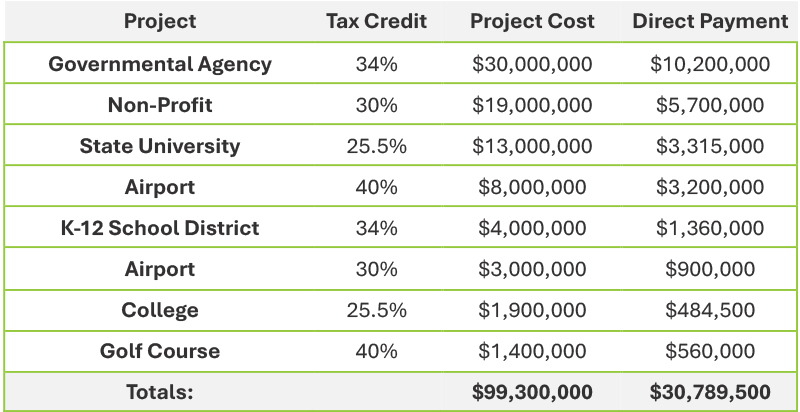
Shown (in the chart above) are some case study examples where tax exempt organizations have received substantial direct payments for their geothermal projects located in New York.
IRA Tax Credits Impact Project Viability
Alternative Energy Credits can drastically improve a project’s viability by reducing upfront project costs by as much as 30-70%.
Properly structuring your project’s tax credit bonuses, labor compliance, and project timeline can turn an expensive capital expense into a feasible investment.
Charles Goulding is president of Energy Tax Savers, Syosset, N.Y.