



News:
Construction Design & Engineering
Posted: March 12, 2012
Executive of the Month: Drucker of HOK is solving complex problems through sustainable design
Kenneth Drucker, senior principal and director of design for HOK NY, is passionate about solving complex problems and weaving his work into the fabric of the city. He believes that architecture must be sustainable while blending both art and science.
Drucker first decided to pursue a career in architecture and design while attending college.
"I was pre-med studying biology and chemistry and taking a sculpture class as an elective my freshman year. I was also volunteering at a research foundation focusing on cancer research where I prepped animals for surgery. After many surgeries I realized premed was not for me and discovered, through my friends in the sculpture class, architecture as a field where I could integrate building science with art."
Drucker subsequently received his MARCH in 1987 from Harvard University's Graduate School of Design.
Drucker's first project was working as a designer for an addition to the Brookings Institution in Washington, D.C., which was also adjacent to the Headquarters for the National Trust for Historic Preservation. "It was an extremely contextual project where the design required an institutional presence along Massachusetts Ave. and then a residential brick façade facing the Dupont Circle Neighborhood."
One valuable lesson that stays with him every day in his work is to "focus on the essence of the idea and have that idea drill down into the details of the project. I am always focused on the quality of the drawings that lead the quality of the built work."
He is actively involved with several upcoming projects. "I am currently working on the 500,000 s/f corporate headquarters for LG Electronics in Englewood Cliffs, N.J., which will be visible from the George Washington Bridge. The project will be LEED Gold and represent our goal of creating designs that integrate architecture, engineering, interiors and high performance engineering, and enclosures. I am also currently master planning both New York-Presbyterian Campuses at 68th and York and Uptown at 165th and Ft. Washington. And special jewel of a project for me is a small infill building for the Singapore Chancery."
What is his favorite part of the design process?
"Conceptualizing of the design with the design team and collaborating with the client to develop a design solution that embodies the character of the client, program, and site. I get very excited during this phase and then, of course, there is always the thrill of the sights and sounds of the construction site."
Several past projects in his career stand out in his mind including a Federal Courthouse in Tucson, Arizona for the GSA, which was part of the Design Excellence Program and received numerous awards. "It is a civic building and responds to building in the desert," he said.
"In New York I am very proud of both the Staten Island Ferry Terminal at St. George since it is patronized by so many commuters; we tried to make the experience so much better for them. But my very favorite is the Colburn School of Music in Los Angeles, diagonally across from Gehry's Concert Hall and adjacent to Isosaki's MOCA. When in LA, I go to some of the children's concerts and I am inspired by the acoustics and performances in the Main Recital Hall."
Drucker has seen a wide range of changes over the years in the design industry. "The biggest change has to do with the influence of technology in representing and delivering our work. Design phase durations have been reduced, technology, and especially REVIT have transformed how we document our buildings. Our designs have become more fluid and complex geometrically because the computer allows us to design complex geometries. Buildings can now be fabricated directly from our computer models."
Drucker is also passionate about sustainable design and how it manifests itself in his daily work. "I am mostly inspired by my desire to make sure that my children and grandchildren have a planet that they can inherit which is better off than today. Sustainable design makes common sense and should be code mandated at this point - similar to the energy codes in Europe and Canada. Buildings represent 42% of the energy use in the U.S. and we need to reduce our carbon footprint. We are focused on designing Net Zero Buildings, buildings that can generate energy and Biomimic-Inspired design - where the performance of our buildings is no different than the natural environment."
This philosophical approach to design is representative of HOK itself. "The design philosophy of the New York office is one of restrained elegance expressing carefully studied performance driven sustainable solutions that achieve the aspirations of our clients and the community. We respond to our clients' needs through innovation in all the work that we do."
MORE FROM Construction Design & Engineering
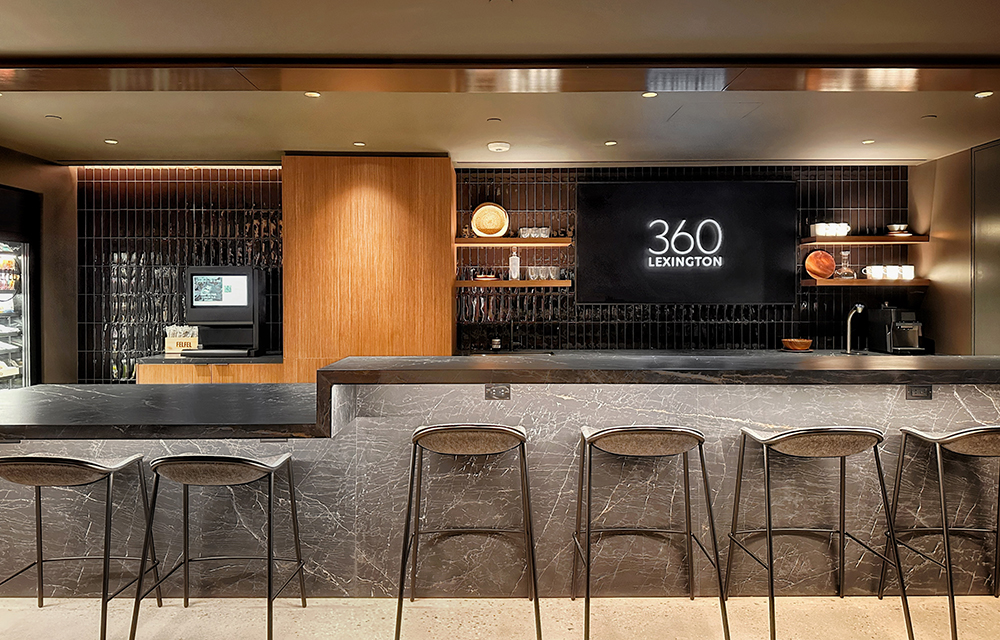
AmTrustRE and MdeAS Architects complete modernization of 360 Lexington Ave. in Midtown
Manhattan, NY AmTrustRE has completed a comprehensive modernization at 360 Lexington Ave. Led by New York-based architecture firm MdeAS Architects, the project reimagines the 268,000 s/f office building as a modern, hospitality-driven workplace designed to meet the evolving needs of tenants.


Quick Hits


Columns and Thought Leadership
Premium experiences, proven returns: The New revenue playbook for sports venues - by Terry McIntyre
Investing in the Fan Experience as a Revenue Strategy The sports and entertainment venues that bet on premium experiences years ago are now seeing those investments pay off in packed seats, increased revenue, and industry recognition.

We support green construction. Just not this kind - by Tammy Smith
Most people think of St. Patrick’s Day as a fun footnote on the calendar. In construction logistics, however, it’s a full-scale operational variable — especially if your work touches major metro areas with major parades and, let’s call it what it is, enthusiastic celebrants.
The Façade is no longer just a finish. It’s a risk strategy. - by Bentley Zhao
Twelve-billion-dollar weather disasters have already hit the U.S. through the first half of 2026, causing at least $31.9 billion in damage, according to Climate Central, the nonprofit that now maintains the disaster database NOAA discontinued.
