


News:
Owners Developers & Managers
Posted: August 3, 2021
Doe Fund receives TOC for veterans’ affordable & supportive housing
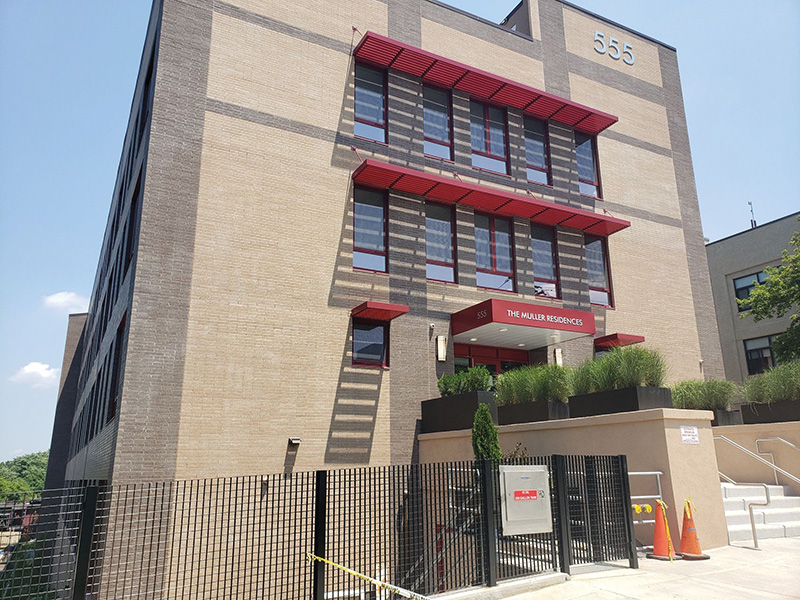 Bronx, NY The Doe Fund has received a Temporary Certificate of Occupancy for the Muller Residences, its latest affordable and supportive housing development. The residence was designed by MHG Architects.
Located at the site of a former Army Reserve center that once manufactured torpedo gyroscopes, the four-story, 51,000 s/f facility now provides 90 units of affordable and supportive housing, with 54 targeted to formerly homeless military veterans. The remaining 35 affordable units will be rented to low-income individuals, with one unit set aside for a live-in superintendent. The residence has begun accepting tenants.
The site, in the Wakefield neighborhood, was acquired by The Doe Fund in September 2013 from the federal government through its Base Realignment and Closure (BRAC) program. Since that time, The Doe Fund has worked closely with Wakefield residents to create a redevelopment plan that responded to local community needs, especially with respect to property revitalization, affordability, and the creation of new community spaces.
The Muller Residences will provide onsite supportive services to tenants, including comprehensive case management, linkages to health care, and other critical services, such as job preparedness, employment training, and drug/alcohol prevention services. Other amenities include 24-hour professionally staffed security, energy-efficient appliances and building systems, an exercise room, and shared community spaces—including a basketball court and an auditorium for community events.
Development funding sources include NYC Department of Housing Preservation and Development (HPD), Sterling National Bank, and Raymond James Tax Credit Funds, Inc. The development also received a social services operating grant awarded through New York City’s 15/15 Rental Assistance Program.
“New York City’s recovery has been a wonder to behold, but we must ensure that it is shared by everyone,” says John McDonald, executive vice president of real estate at The Doe Fund. “That means addressing the housing crisis by providing vulnerable New Yorkers with a place to call home. It means improving public safety by alleviating the root causes of crime: poverty, lack of opportunity, and mental illness. Muller will uplift individuals, families, and veterans struggling to escape homelessness after bravely serving our country. With comprehensive, onsite social services, tenants will have access to the support they need to live with dignity and stability.”
MORE FROM Owners Developers & Managers

Cord Meyer Development breaks ground on new residential community at the Bay Terrace Shopping Center
Queens, NY On September 10, Cord Meyer Development celebrated the groundbreaking of its new residential community at the Bay Terrace Shopping Center, marking a major investment in new housing and the continued evolution of one of







Columns and Thought Leadership

IREON Insights: Research and development tax credit: Very important deadline for amendments is July 6 - by Richard Levychin
If you are a company that either claimed or qualify for the research and development tax credit you need to be aware of the following update resulting from the One Big Beautiful Bill Act (OBBBA).

Don’t leave severance damages behind - by Sebastian Jablonski
When the government takes a portion of a landowner’s property, most assume just compensation stops at the value of the land taken. However, in partial takings, that is only half of the equation.

Hunt Commercial Real Estate Q&A: Location, location, location? - by David Hunt
In working with our clients, we break down our search objectives into two categories. The first category involves the specific needs of your business such as warehouse height, amount of office space and number of loading

NYC's Community Opportunity to Purchase Act is back - and multifamily owners should pay attention - by Ron Cohen
New York City’s Community Opportunity to Purchase Act (COPA) is back, and this latest version could have a much better chance of becoming law. The proposal would give qualified nonprofit organizations
September Promotion
