


 (2).gif)
News:
Spotlight Content
Posted: April 19, 2016
CREW Network study tracks 10 years of progress by women in commercial real estate
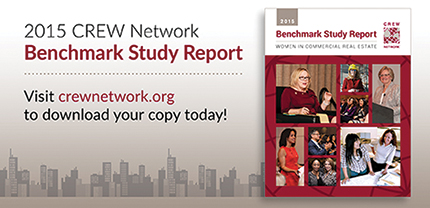 CREW Network 2015 Benchmark Study Report
CREW Network’s research reflects a diversity of positions and specializations within the commercial real estate industry. Respondents spanned entry-level to C-suite positions and represented all major specializations within the field – asset and property management, brokerage and sales, development, and financial services.
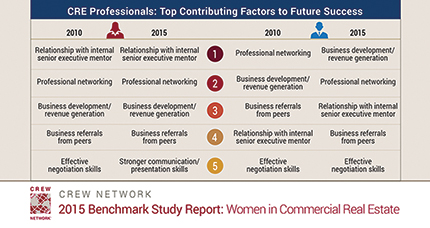
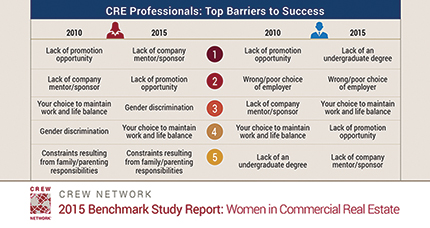
Survey respondents revealed gains made by women in commercial real estate, and areas where inequalities persist. Key findings from the study:
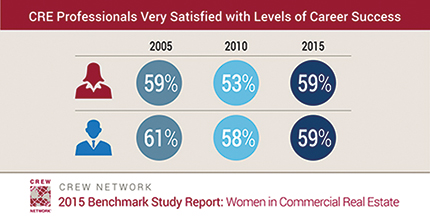
• Womens career satisfaction and feelings of success increased across all industry specializations. Women with higher commission-based pay reported the highest career satisfaction.
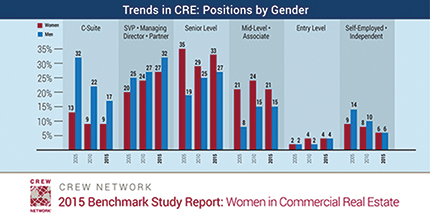
• More women fill senior vice president, managing director and partner positions than ever.
• The percentage of women with direct reports is now on par with their male counterparts.
• An aspiration gap exists between men and women in commercial real estate: 28% of women surveyed aspire to the C-suite vs. 40% of men; 47% of women respondents aspire to the senior vice president, managing director or partner levels.
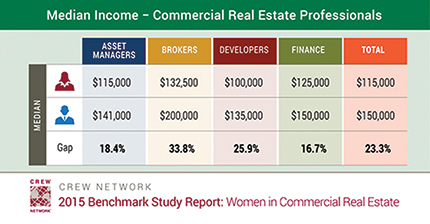
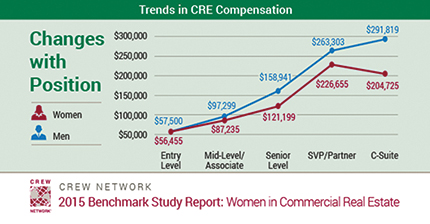
• In 2015, the industry median annual compensation was $115,000 for women and $150,000 for men – an average income gap of 23.3%. The income gap was widest in the C-suite at 29.8%.
• One in five women surveyed said that family or marital status has adversely impacted their career or compensation.
The 2015 study findings will enhance CREW Network’s research and program agenda, including existing mentoring and targeted programming for senior women. Sixty women are currently enrolled in the inaugural CREW Network Certificate in Leadership program, which offers year-long specialized leadership development, industry training, and mentors who are familiar with the challenges in the commercial real estate work environment.
The Certificate in Leadership curriculum was developed from previous CREW Network research findings indicating that women are often reluctant to take risks, negotiate salaries and develop specific career plans that allow them to advance at the same pace as their male counterparts. On June 17 in Detroit, Guhan Subramanian, tenured professor of the Harvard Law and Business schools, will instruct a day-long Certificate in Leadership course on negotiations.
CREW Network enlisted the MIT Center for Real Estate as its independent research partner to survey, tabulate, analyze and produce the 2015 benchmark report. In 2015, respondents were asked the same questions from the 2005 and 2010 surveys to guarantee data integrity and consistency; 2,182 professionals in the commercial real estate industry successfully completed the survey between March and October of 2015.
The study was made possible by the support of CBRE, premier underwriter; senior underwriter Prudential and associate underwriters CREW Dallas, Cushman & Wakefield | PICOR, Fidelity National Title and the National Multifamily Housing Council. About CREW Network
CREW Network is the industry’s premier business networking organization dedicated to advancing the achievements of women in commercial real estate. CREW Network members comprise nearly 10,000 professionals worldwide and represent nearly all disciplines of commercial real estate – every type of expert required to “do the deal.” Follow CREW Network on Facebook, Twitter, LinkedIn and Instagram, and visit us at www.crewnetwork.org.
Tags:
Spotlight Content
MORE FROM Spotlight Content

Participate in Developing New York Featuring Westchester County - November 24, 2026
Choose how you’d like to participate in this edition of NYREJ’s Developing New York series featuring Westchester County.




.png)

Quick Hits
 (2).gif)

Columns and Thought Leadership

2026 Developing Queens: Long Island Board of Realtors advances commercial growth and advocacy in Queens
The Long Island Board of Realtors (LIBOR) Commercial Network continues to play a key role in advancing opportunities and strengthening the commercial real estate landscape across Queens. Through targeted programming and global outreach

From vacancy to vitality: How adaptive reuse is reshaping Long Island’s CRE landscape - by Andrea Tsoukalas Curto
Adaptive reuse has become one of the most important conversations in commercial real estate today. Long Island has a large inventory of aging retail, office and industrial

CRE Guide Featured Company: Merritt Environmental Consulting Corp.
Merritt Environmental Consulting Corp. (MECC) was established in June of 2009 after being part of a larger engineering firm for almost 20 years. The focus of the company is to assist lending institutions, attorneys, real estate investors, and property owners with environmental concerns. Today, MECC has offices in New York, Florida, and Vermont and has grown into a regional consulting firm serving clients along the East Coast.

2026 Developing Long Island: ERG Commercial Real Estate launches its new Retail Leasing division
North Hempstead, NY ERG Retail Leasing is the dedicated leasing division of ERG Commercial Real Estate, an established full-service commercial real estate brokerage for over 35 years.