



News:
Brokerage
Posted: April 18, 2008
The "Sustainability Age:" Adaptive re-use allowing the old to become new again
We are onto something! Could this be the latest age in American history? As we take a quick look back, Americans have been quick to define significant events in our history with "_________" Age. We have the Industrial Age, a potent representation of technology, prosperity, luxury, and progress. The Information Age, an era where information rapidly spread from the 1980s onward. The Global Age, the connectivity of economies and ways of life across the world. And yes the "Sustainability Age."
Across America companies, schools, retailers and residential housing developers are jumping on the band wagon of "sustainability." The Bank of America in Manhattan, designed by Cook & Fox, developed ways to capture rain water that falls on the roof for re-use and also uses scraps from the cafeteria to produce methane as a supplementary fuel for its generator. Lawrence Kinney, a home builder in Traverse City, Michigan is building vacation homes using plaster walls instead of resource intensive drywall, lumber harvested locally by horse-drawn teams, and stains made from plants instead of petroleum. FedEx's Oakland airport hub has installed 81,000 s/f of solar panels which provides 80% of the facility's electrical needs. And the list goes on.
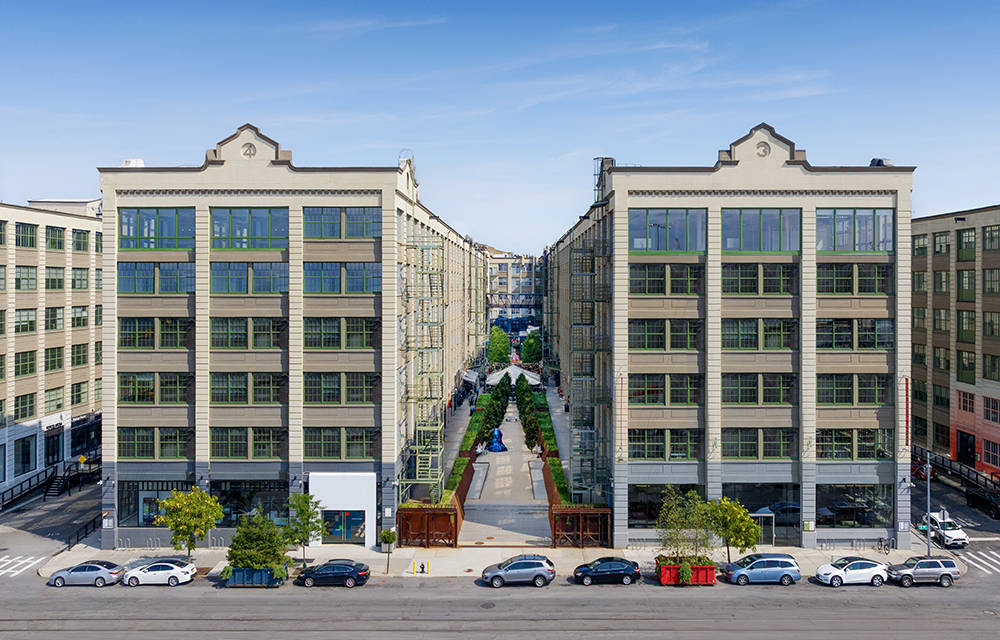
Under the banner of "sustainability" is "Adaptive Re-Use," a process that adapts buildings for new uses rather than demolishing old structures. In short, it is recycling for buildings. This trend, which began with the conversion of old schools into apartments, condominiums, and senior housing is now catching on in the health care industry.
Adaptive re-use allows owners to work with an existing building and rework the interior to suit their specific needs. Old facilities, be it warehouse, retail or medical may be obsolete from the perspective of their original intended use, but may have the potential for a new life that is unrelated. These buildings may be attractive candidates for adaptive re-use because of their scale, architectural style, location, and proximity to urban centers.
In Muncie, Indiana a growing medical practice needed more space to accommodate its 45 physician multi-specialty group. The area offered few options for large-scale office space and with a little ingenu-ity and non-traditional thinking; the physicians converted a vacant grocery store into a spacious new office. The old grocery store with about 33,000 s/f of usable space is now home to several related medical specialties.
A similar adaptive re-use project in Jackson, Mississippi converted a 191,000 s/f mall in an economically depressed neighborhood into a thriving center for one-stop health shopping. The Jackson Mall which was built in 1969 was once the home of three major department stores but became an eyesore and the community wanted a new use that would revitalize the neighborhood. The medical center moved quickly and purchased the mall to open the new medical center which provides a number of services which include a mammography center, a cardiopulmonary rehab center, a diabetes education center, an artificial kidney unit and the Adolescent and Child Tobacco (ACT) Treatment and Research Center. Even the 700 seat movie theatre was repurposed into meeting rooms and conference center for both the Medical Center and the community.
A 1958 Montgomery Ward retail store, which was built in the heart of Tyler, Texas, sat vacant until a group of physicians visualized the site as a hospital. The two-story 88,380 s/f building was modified and increased to 95,925 s/f to house the existing Texas Spine and Joint Hospital. The hospital comprises an acute care space for 20 private inpatient beds, three orthopedic surgery suites, and six recovery beds. Outpatient services provided space for three pain treatment rooms. There is a radiology department with an MRI, CT and RF room.
Harvard University has taken to the adaptive-reuse process as well and in 2003 converted the former 435,000 s/f English High School into a medical research center for its Institute of Medicine. In Dayton, Ohio a 327,000 s/f historic structure built in 1852 as a hospital was converted into a 223-unit congregate care facility. The facility also includes assisted living, a 300-seat formal dinning room, a full service kitchen, a bank, separate men's and women's health spas, plus hobby and craft areas.
In Syracuse, VIP Structures/VIP Development Associates have taken their "master builder" approach of integrating conceptual design with functional performance to transform a 105,000 s/f office building into a class A medical building.
The interior of the building was completely reworked to boast a soaring three-story atrium, which allows natural light to filter through the building's common area. The building comprises a mixed-use of medical service providers ranging from laser eye surgery and kidney disease treatment to dental services.
So, what was old is new again.
Christianne Radziewicz is a business development representative at VIP Structures, Inc., Syracuse, N.Y.
Tags:
Brokerage
MORE FROM Brokerage
NYSCAR June 2026 president’s message - by Mercedes Brien
As I write this letter, we are preparing to be at the Annual Conference being held at the Rivers Casino, Schenectady, New York. I look forward to reporting on the conference in my next letter. We have some great courses coming up via Zoom. Please be sure to keep watch on upcoming courses by visiting nyscar.org/resources and tools/professional development.




Columns and Thought Leadership

A fresh start - by Shallini Mehra and Amit Doshi
For the past several years, the New York City multifamily housing market has been defined by disruption. The combined impact of the HSTPA rent laws and a sharply higher interest rate environment has fundamentally reduced
The anticipated effect of Basel III and ISO 20022 implementation on commercial real estate - by Michael Zysman
July 1, 2025 is the deadline for US banks to begin to adopt Basel III banking standards and July 14, 2025 is the deadline for U.S. banks to adopt ISO 20022 messaging standards. Both will have a significant effect on the banking and commercial real estate (CRE) finance sectors.
The death of the generic offering memorandum: What buyers expect in 2025 - by Kimberly Zar Bloorian
There was a time when an offering memorandum (OM) was pretty bare bones, some photos, a few bullet points on income, and a rent roll thrown in at the back. That used to get the job done. Not anymore. In 2025, buyers are sharper, faster, and more selective. They’re looking

Tri-state capital migrates nationally amid regulation pressure - by Reese Weaver
New York tri-state multifamily investors are increasingly reallocating capital to less-regulated markets across the U.S. as rent control and legislative risk erode returns at home. With over 60% of New York City’s rental housing stock classified as rent-stabilized, the traditional value-add model — buying under-performing buildings,
